Showing posts with label Metal neck. Show all posts

Sunday, October 23, 2011

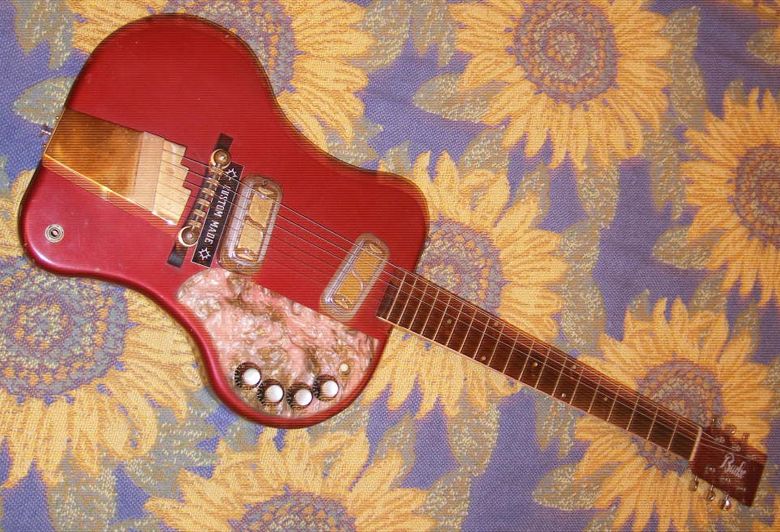
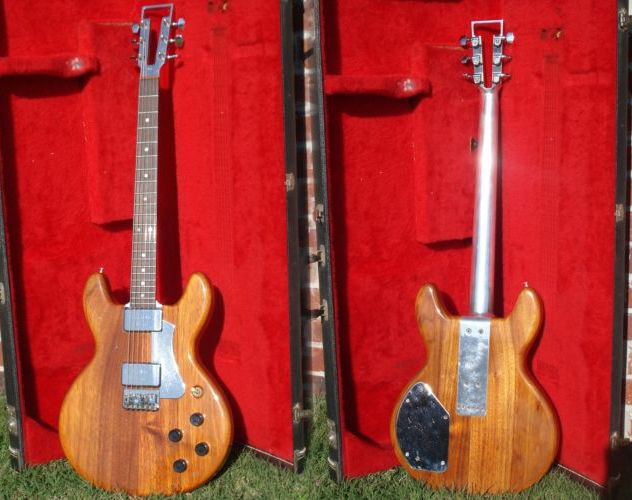
Burke, USA-made, aluminium-necked electric guitar, design patented in 1961

guitarz.blogspot.com:
Apologies for the sub-standard photo, but this was the only one that showed the entire length of the guitar in question face on.

The eBay seller claims that this 1960s Burke electric guitar in metallic burgundy finish was the very first electric guitar to feature an aluminium neck and was thus the forerunner to Wandre, Veleno, Travis Bean, et al. Apparently Glen F. Burke patented the design in 1961. Whether the patent was for the concept of an aluminium neck or if it was for the entire design of the guitar, we are not told; I suspect the latter.

The aluminium neck runs all the way through the body to the end strap button, so it's actually an aluminium neck and centre block with pickups and bridge sitting upon it. The fingerboard is rosewood and the body itself is maple and is hollow, no doubt contributing to the instruments allged "acoustic tone". The body shape is most peculiar, looking as if a symmertical design had been sawn down the middle and one half flipped over. (In fact, I am reminded of this).

The pickguard is odd in that it has no screws mounting it to the body, but instead is kept in place by the pots for the controls, which are comprised of a volume and tone for each pickup, and a 3-way pickup selector.

This guitar is currently listed on eBay with a Buy It Now price of $10,000.

Thanks to Jeffrey Jones and to Dirk Lubbe who both emailed me about this guitar.

G L Wilson

© 2011, Guitarz - The Original Guitar Blog - now in its 10th year!

Sunday, October 16, 2011

Staccato MG bass, circa 1986, made from magnesium alloy and fibreglass

guitarz.blogspot.com:
This Staccato MG bass from 1986 is one of approx 200 guitars/basses built in the UK by Pat Townshend. I recall these guitars well from when they were first introduced, and remember seeing them at a music show in London, I'm guessing, in 1986. As I remember Chris Jagger (Mick's brother) was also involved in the company, and no doubt it was through his connections that these guitars were used by Mick Jagger and Bill Wyman in the Rolling Stones. Other endorsees included Gene Simmons of Kiss, and Motorhead's Lemmy (and if memory serves me correct, I saw Lemmy's bass exhibited at the above-mentioned music show).

The neck and centre body section is cast in one piece from magnesium alloy. Perhaps some more knowledgable readers can confirm this, but I seem to recall reading something to the effect that all the magnesium used in these guitars was filtered from sea water (magnesium being an element dissolved in sea water) and as such provides a material that made these guitars very environmentally friendly. Depending on the process employed to extract magnesium from water, that is.

The outer part of the body is made from fibreglass and seems to have been sculpted to provide for an ergonomic and body-fitting shape. Note that the strings are anchored at the headstock whilst the tuners are situated at the other end of the instrument behind the bridge. Pickups are double-bladed sealed units which are concealed within the magnesium centre body block with only the blades themselves protruding through to the front.

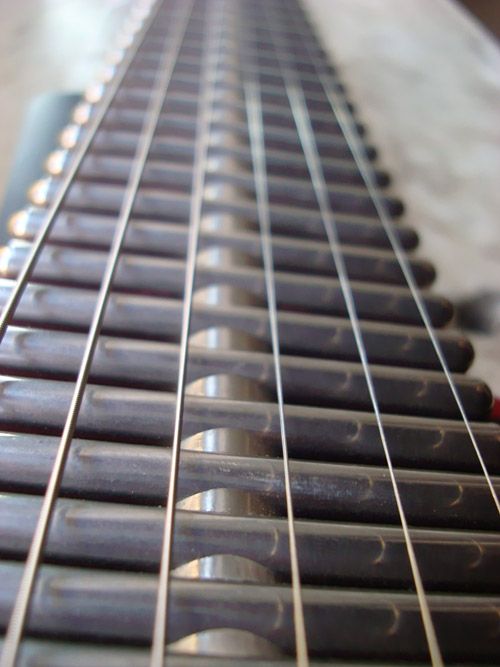
The fingerboard is made from an industrial plastic material and is fitted with 22 very low flat frets, which almost brings to mind the strange fretboard of the Lane Poor bass.

Unless my memory is playing more tricks on me, I believe Staccato offered basses and guitars with exchangable bodies / necks where the centre neck section could be swapped out for another guitar or bass (or converserly the body could be changed for say one in a different colour).

This eBay auction for this bass is finishing in 11 hours as I write; the starting price is $1,999 and Buy It Now price is $2,499.

G L Wilson

© 2011, Guitarz - The Original Guitar Blog - now in its 10th year!

Tuesday, October 11, 2011

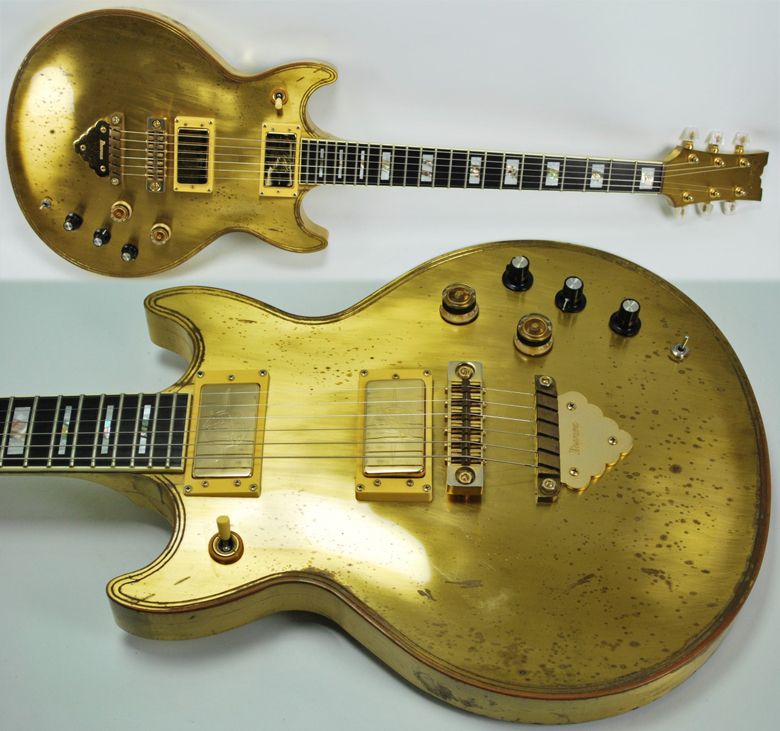
One-off 1970s Ibanez Artist made from solid brass is quite literally Heavy Metal

guitarz.blogspot.com:
Wow! I mean we've seen metal guitars before, but not any made from solid brass. That's right, solid, not plated. I couldn't say whether or not the guitar body is chambered, but weighing in at a whopping 70 lbs it's possible that this one-off brass Ibanez Artist IS solid all the way through! Imagine what that must feel like... and you thought a Les Paul was heavy! Despite the weight, apparently it IS fully playable and has recently been professionally set up. Looking at the condition of the body with scrapes and dings it looks like it may have been used over the last 4 decades too.

But "WHY?" you may well be asking. Apparently it was created as a centre piece for the unveiling of the Ibanez Artist line at NAMM sometime in the mid 1970s. (Has anyone got a more specific date for me here?)

Other than unusual choice of body material, specs are: 25" scale, 1 11/16" nut width, ebony fingerboard, Flying Fingers humbuckers, active 3-band equalizer.

This one of a kind guitar is currently listed on eBay with a Buy It Now price of $24,999.95.

Thanks to Jason Moody for bringing this guitar to my attention.

G L Wilson

© 2011, Guitarz - The Original Guitar Blog - now in its 10th year!

Tuesday, October 4, 2011

Wandre Doris: an eccentric 1960s Italian original

guitarz.blogspot.com:
Wandre Guitars were designed by Wandre Pioli (1926-2004) and built in his factory in Cavriago from 1959 to 1969. The Wandre Doris is a beautifully eccentric example, featuring Wandre's aluminium neck covered in polystyrene coating. Note the 6-in-a-line timber and aluminium slotted headstock and note also how the neck is almost parallel along its length, which is common on Italian guitars of this vintage. The moulded pickguard is resplendent in 3-dimensions and incorporates pushbutton pickup selectors and and angled output jack. These guitars were from a day and age when you didn't see the same old generic components on each and every instrument. The tremolo is quite a wonderful affair looking as if it's been assembled from motorcycle parts.

The Doris model has been re-issued by Eastwood Guitars (and kudos to them for reviving all those retro designs) but you wouldn't really mistake it for the real thing unless seen from a distance.

This original 1960s Wandre Doris is currently listed on eBay with a Buy It Now price of $5,500.

G L Wilson

© 2011, Guitarz - The Original Guitar Blog - now in its 10th year!

Thursday, September 22, 2011

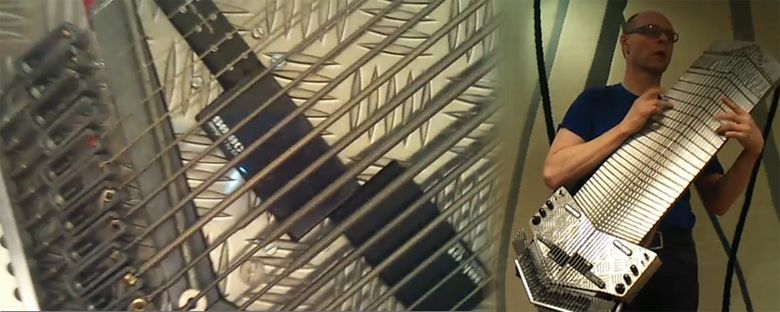
Dude taps away on 24 strings on his homemade monster metal bass

guitarz.blogspot.com:
Cor blimey, guvnor! When I first saw the picture of this thing I thought it might be a Star Trek fan posing with some exotic piece of Klingon weaponry. But no, apparently it's a touch-style 24-string "bass" (not sure why it can't be called a "guitar", but that's what the fellow calls it).

I know, I've been very cynical in the past about such multi-stringed instruments and "extended range basses", and even have my own catchphrase to be used in the eventuality of sighting such a beastie: "Is that enough strings? Just buy a harp already!"

But I've been told that I shouldn't be so closed-minded, so I'll let you watch this chappie in action on his 24-string bass in the below video and allow you make up your own minds.


Actually, someone commented on YouTube, "Whats the point in having that many strings?", and 24-string bass chappie answered, "There is no 'point', I just love to play stringed instruments!" which, I guess, is fair enough. It's like the answer to the old question "Why climb that mountain?" with "Because it's there!" In this instance, it's "Why have so many strings? Because I can!"

Love it or loathe it, it doesn't matter. It's worthy of a blog post on Guitarz for weirdness factor alone.

G L Wilson

© 2011, Guitarz - The Original Guitar Blog - now in its 10th year!

Wednesday, September 14, 2011

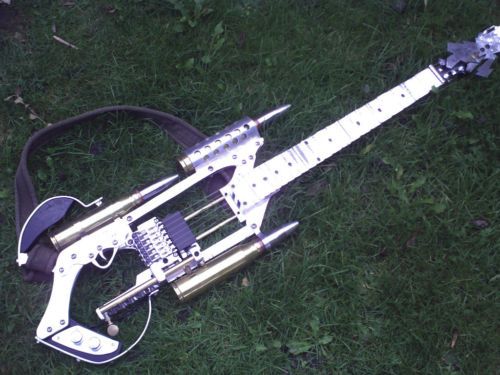
30mm Lock 'n' Load guitar with sliding pickup, aluminium neck and stepped fingerboard

guitarz.blogspot.com:

I make no secret of the fact that I dislike guns intensely and have absolute contempt for that old cliche, the guitar shaped like a gun.

However, this 30mm Lock n Load custom guitar, which still looks like some piece of military hardware, I find quite intriguing. It does have a "steampunk" feel to it.

It has a sliding pickup on a bolt-action system allowing it to be set in any one of six positions. The neck is aluminium (it looks like it could benefit from some wooden inserts on the rear - see video) and the integral fingerboard is stepped, a la Bond Electraglide.

In the seller's favour is his refreshing honesty when telling us that the guitar weighs a whopping 15.4lbs/7kg and would be "only good for one song at a gig".

See more of the guitar here:


It's not really to my taste, but is still worthy of including here on Guitarz as an example of something quite unusual.

EDIT: As Big Red X points out in the comments, this would appear to have been made by British Custom Guitars.

G L Wilson

© 2011, Guitarz - The Original Guitar Blog - now in its 10th year!

Tuesday, May 31, 2011

Check out the wiring on this crazy metal guitar

guitarz.blogspot.com:
Guitarz reader Elad found this metal guitar on eBay. He writes:
This was offered on eBay with a start price of 99.99$, gained some bids, but then ended early by the seller for an unknown reason.
Even though it is hollow with the body made in two halves (and hinged so it can be opened up!), it looks to be pretty chunky. I sure hope that it's made of aluminium and not anything even heavier! And just check out all that wiring inside. That looks like it would be a nightmare to sort out. It appears there's a series of LEDs around the top and sides of the guitar so I guess it has a built-in "light show" of sorts. The trem arm is a pretty unique shape too - looks like it might double as a bottle opener.

See more, bigger photos, etc, over at Elad's blog TonePedia.

G L Wilson

© 2011, Guitarz - The Original Guitar Blog - now in its 10th year!

Saturday, January 29, 2011

EGC alu and lucite guitar

guitarz.blogspot.com:
(c) AE|2011, http://photography.fuzz-wire.net
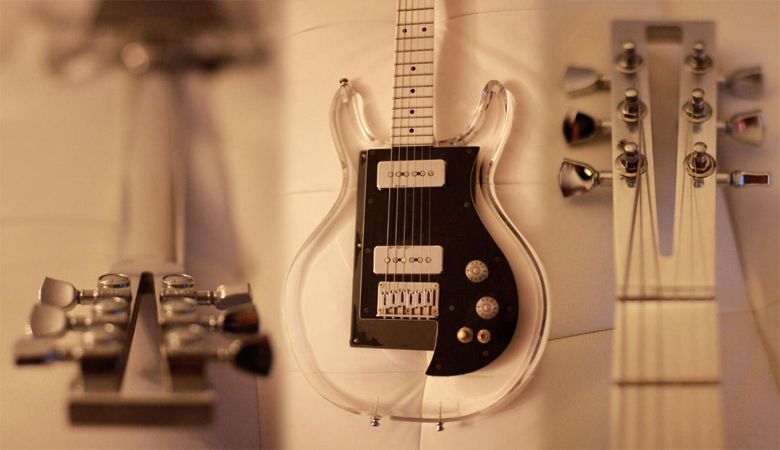
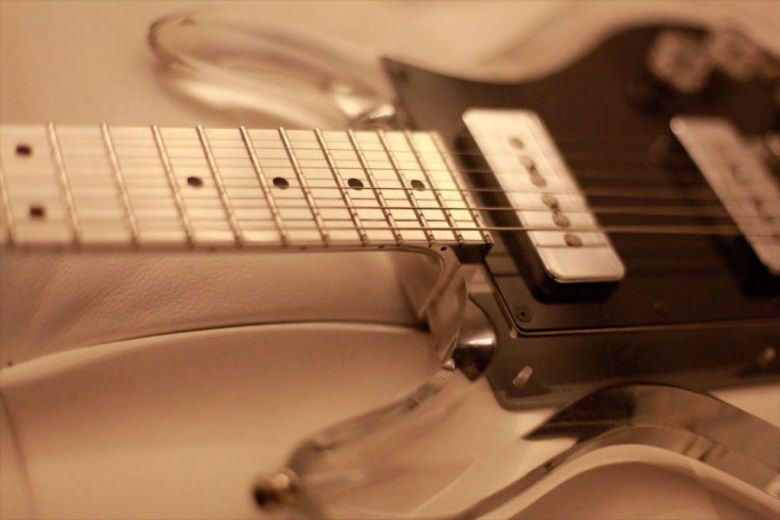
Kevin Burkett of the Electrical Guitar Company creates boutique-quality aluminium guitars and basses. This particular example is a one-off, inspired by the now legendary Dan Armstrong plexiglass guitar, and which marries a lucite body to an aluminium Travis Bean-style neck. Unlike the Dan Armstrong which had such a deep-set neck that there was only room to accommodate a single pickup, the EGC has two P90s. Indeed, from what I can make out in the photographs, the neck/body interface looks to be one of its most interesting features. It appears that the neck and the plate at the rear of the body are formed from a single billet of aluminium, allowing the end of the neck to be flush with the top-end of the body with no need for neck pocket or deepset tenon.
(c) AE|2011, http://photography.fuzz-wire.net
More here: http://digital.premierguitar.com/premierguitar/201003_1/#pg193

Thanks to Dirk Lubbe for bringing this beauty to my attention.

G L Wilson

Guitarz - The Original Guitar Blog - now in its 10th year!

Saturday, January 22, 2011

Vaccaro X-Ray V2 with an aluminium neck


You probably think that you've seen the characteristic V-shaped metallic headstock of this Vaccaro X-Ray V2 before - you're right, that's the Kramer one, from the time - back in the 1970s - they were making alu neck guitars. Mr Vaccaro is actually one of the founders of Kramer Guitars, and together with his son bought the patent for the necks and headstocks after Kramer crushed, and after upgrading them created the eponymous but short-lived company that released this guitar.

Bertram

Guitarz - The Original Guitar Blog - now in its 10th year!

Saturday, May 15, 2010

Anthony Goulding unveils his latest aluminium creation

guitarz.blogspot.com:
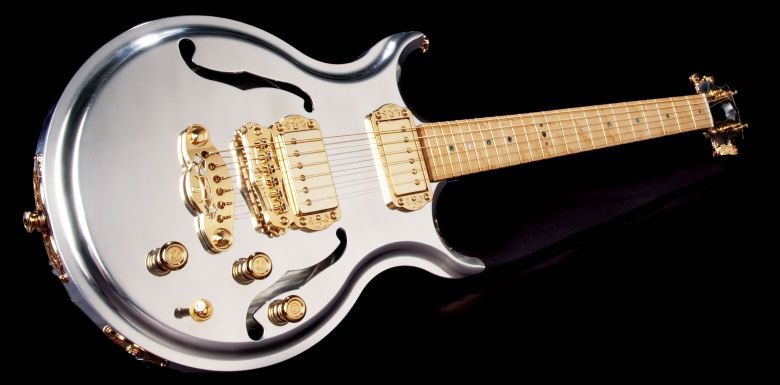
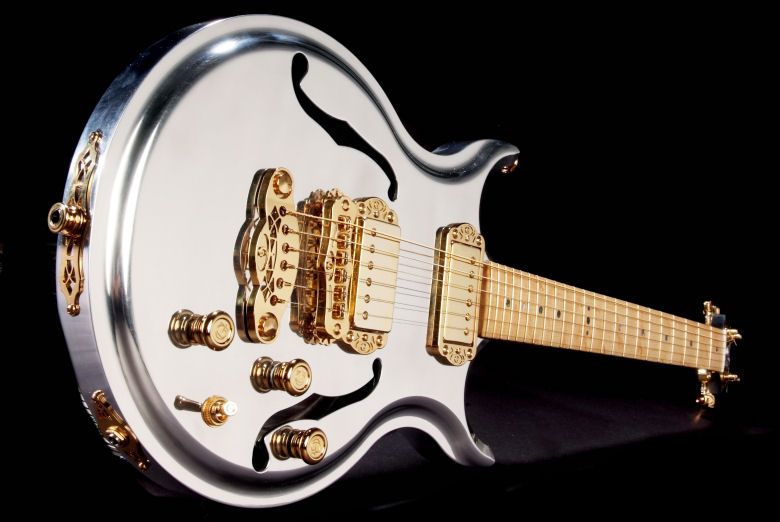
This latest guitar from Goulding Guitars is a real beauty. It has a polished aluminium body and neck, birdseye maple fretboard with gold evo frets, Bareknuckle humbuckers with coiltap, with all hardware/bridge/tailpiece/pickup surrounds/knobs etc designed and made by Anthony Goulding from gold plated brass. The bridge incorporates piezo saddles leading to separate strap pin jack socket, and the total weight is 7lb.


G L Wilson

Guitarz - The Original Guitar Blog - now in its 9th year!

Saturday, April 3, 2010

1977 Kramer 450G with alu neck

kramer alu neck

Here is an early Kramer 450G ; the Kramer series of guitars with experimental aluminium + wood necks and charateristic forked headstocks lasted from 1976 to 1985, together with the rise of Heavy Metal, and was the must-have guitar for plenty of hairy guys.

I could make a developed post about it but I would just paraphrase this site - so if you want to know more, pay them a visit! And if you're interested in metal necks and big sustain, check this post about Travis Bean and Sunn O))).

bertram

Guitarz - The Original Guitar Blog - now in its 9th year!

Thursday, February 25, 2010

Stephen O'Malley of Sunn O))) and Travis Bean aluminium-necked guitars

guitarz.blogspot.com:
Here's a recent email from Gary:
I've been a religious follower of your blog the past couple years and I have a problem here that I'm sure you're used to getting millions of e-mails a day about. I've attached some pictures of a guitar played by Stephen O'Malley of Sunn O))) and many other droney, experimentaly type projects. Note the T-shaped cutout on the headstock. It also appears that it has an aluminum bolt-on neck with a large tongue that fits into the body. And are the strings through the body and into the tongue (essentially the neck itself)? I don't see myself as anything close to an expert on guitar design but couldn't that offer some massive sustain? I recently bet a friend of mine that I could find out what it was before him so any help whatsoever would be greatly appreciated. And any insights you might have into the guitars design (like me being ridiculously wrong for example) would be awesome.
Hi Gary

It's a Travis Bean - which were a forerunner to the metal-necked Kramers. You are quite correct about the construction of the guitar and yes - they are known for their massive sustain.

See the Guitarz archives for a Travis Bean "display guitar" (that looks cruelly butchered) and a little bit of info.

There's also a TB1000S on eBay right now:

Thin Lizzy's Brian Robertson can be seen playing a Travis Bean in some of the band's videos from the 1970s. I'm pretty sure that Bill Wyman played a Travis Bean bass in the Stones for a while too.

G L Wilson

NB: Please make sure you are reading this Guitarz post at guitarz.blogspot.com and not on a Scraper blog that copies posts without permission (and steals bandwidth) so as to profit from advertising. Please support original bloggers!

Tuesday, February 23, 2010

Gittler Guitar

guitarz.blogspot.com:

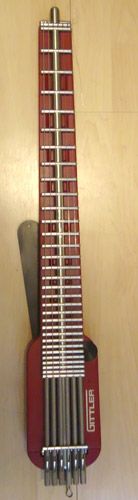
The original handmade Gittler guitar was an object lesson in minimalism. Here was something that looked like a cross between a metal fish skeleton and a TV aerial, yet is was actually a fully-functioning guitar.

The design not only dispensed with the headstock but even the bulk of the neck itself. The neck was simply a steel rod supporting a series of smaller steel rods acting as frets. What there was of the body consisted mainly of six steel rods running beneath the strings. Each of these contained a pickup - one for each string allowing for interesting stereo and panning options.

Original examples were built by Alan Gittler in the late 1970s. In the early 1980s, production instruments were built in Israel by the Bar Rashi company founded by Alan Gittler. There were two models, both of which now had small plastic-resin bodies containing the electronics, whilst one model had the same plastic material forming a "back" to the neck. This latter version is the one we see pictured here and an example of which was recently offered for sale on eBay. For a picture of the version without the plastic neck back, I refer you to pp.140-141 of 500 Guitars (another little plug there!).

I was fortunate enough to be able to try out each of these models soon after they went into production back in the day. You'd imagine that the model with the plastic material behind the neck would be easier to play. It wasn't. It just made for an uncomfortable, bulky neck. Aesthetically it's not as nice either.

However, the other version - the proper fish skeleton model - I loved.

It wouldn't be a good guitar for shredding on, and I think you'd need to adapt your playing style especially for the instrument. For starters, you need to have the thumb of your left hand firmly on the back of the neck in a classical playing position. I saw one guy trying it out who insisted on wrapping his thumb over the top, Hendrix-style, and that just didn't work. Possibly, you could use this as a tap-style instrument. I think it's one that you need to approach with fingers lightly floating over the frets (I can's say "fretboard" because there isn't one!). It's not a neck you are able to hold, as such.

Alternatively you could view it as the utlimate in scalloping!

If you want to see one in use, most people will point you in the direction of the video of "Synchronicity II" by The Police, but here Andy Summers is merely using his (pre-production) Gittler as a prop. The only example I can find of someone genuinely playing a Gittler is here.

G L Wilson

NB: Please make sure you are reading this Guitarz post at guitarz.blogspot.com and not on a Scraper blog that copies posts without permission (and steals bandwidth) so as to profit from advertising. Please support original bloggers!

Sunday, January 31, 2010

Buddy Miller shows us his Wandre Davioli guitar

guitarz.blogspot.com:

We've often talked about Wandre guitars on this blog. Here's Buddy Lee telling the story of how he found his and why he likes it so much.

Thanks to Andy Stone for bringing this video to my attention.

G L Wilson

Thursday, November 19, 2009

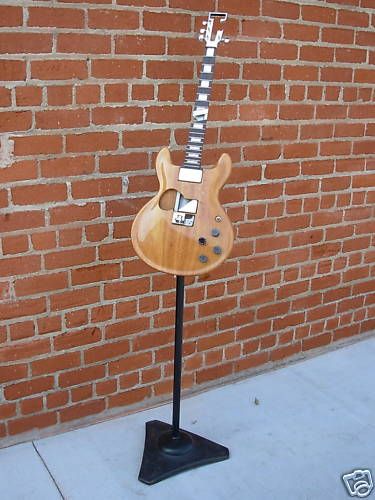
Travis Bean TB1000 display guitar

guitarz.blogspot.com:
Travis Bean guitars were first produced in 1974 and utilised an aluminium neck design, with the neck set deep into the koa body beneath the pickups and bridge with the strings passing through the aluminium centre section for increased sustain.

The design later evolved in the early Kramer line of guitars, which similarly had aluminium necks. These differed from the Travis Bean design in that each neck was essentially a T-section with two fillets of wood along its length so as to approximate the feel of a traditional wooden neck.

This particular example is a one-off Travis Bean display guitar and will surely appeal to collectors of this brand. (It's hardly going to appeal to someone wanting a working guitar!)

According to the listing this guitar was "built by Travis Bean factory to demonstrate the design and build techniques of the legendary Travis Bean Guitar. This guitar was hand carried by Travis himself to several musical instrument trade shows and was set up in the offices of the California factory. It is complete with its very own hand crafted stand and traveling box. Was purchased from famed Travis Bean employee Obie."


G L Wilson

NB: There are a lot of blogs STEALING content and bandwidth. If you read this anywhere else but on guitarz.blogspot.com then you are reading a blog that STEALS content. Please support original bloggers!

Friday, June 12, 2009

London International Music Show 2009

It's June which means it's time for the London International Music Show (LIMS09), which once again is being held at the ExCel Centre in London's East End and is on for four days until Sunday 14 June.

When you enter the hall you can always tell it's a music fair even if you've been blindfolded, because amid the sheer cacophony of sound you can always hear someone thinking he's the next Mark King slapping away on a bass guitar as if the 1980s never went away. It always happens at these events. I think it's a tradition or an old charter or something.

Of course, in recent years it was the London Guitar Show, last year it was the London International Music Show incorporating the London Guitar Show, now they've dropped the Guitar Show moniker altogether. I think some other instruments wanted a look-in too, and that's not really a bad thing, and there's still plenty of guitars to look at, play, and generally lust after. Or even laugh at.

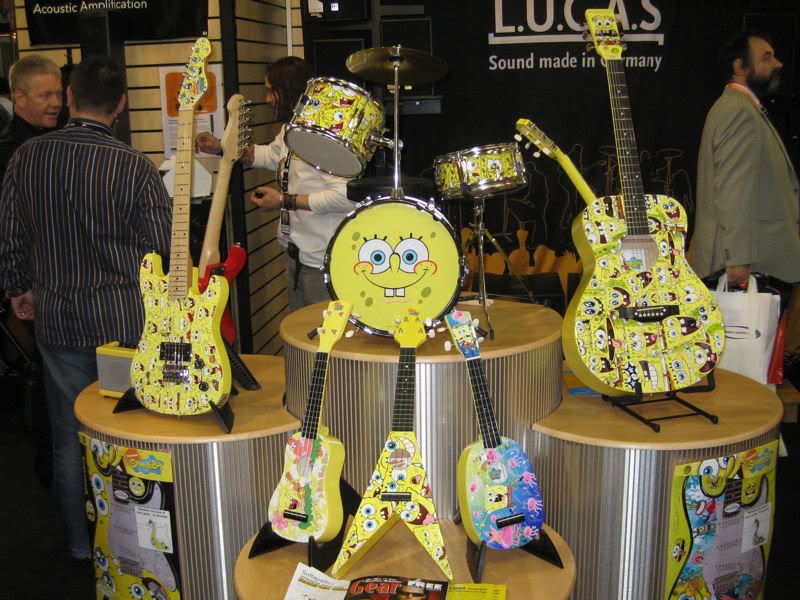
Speaking of which, you'll notice I started this post with a photo of a display of Spongebob gear. Well, that's got the ridiculous out of the way. Let's look at some more serious stuff!

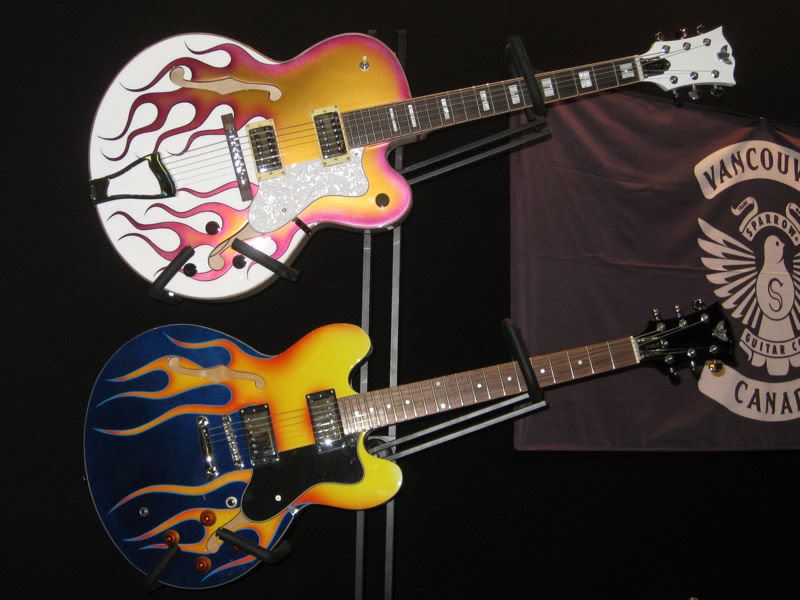
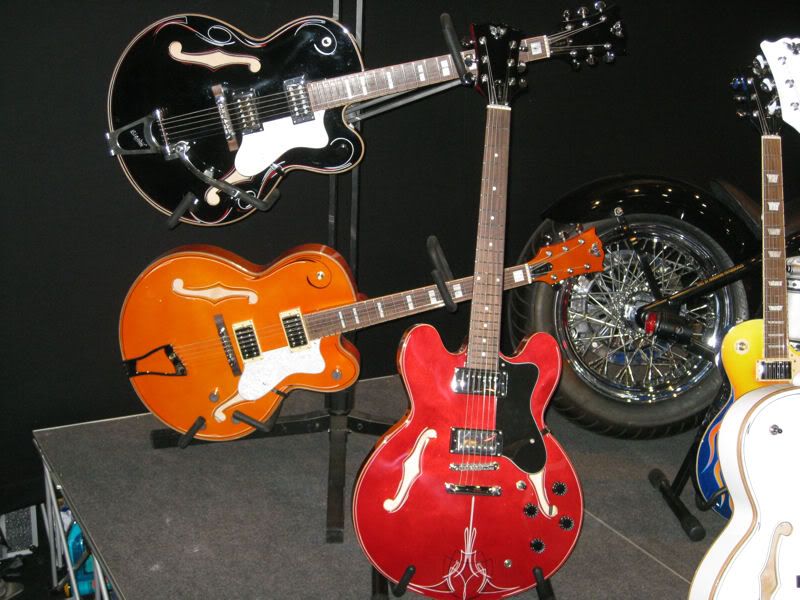
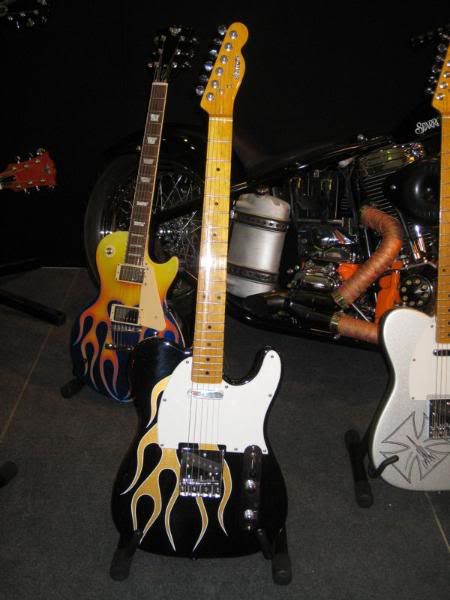
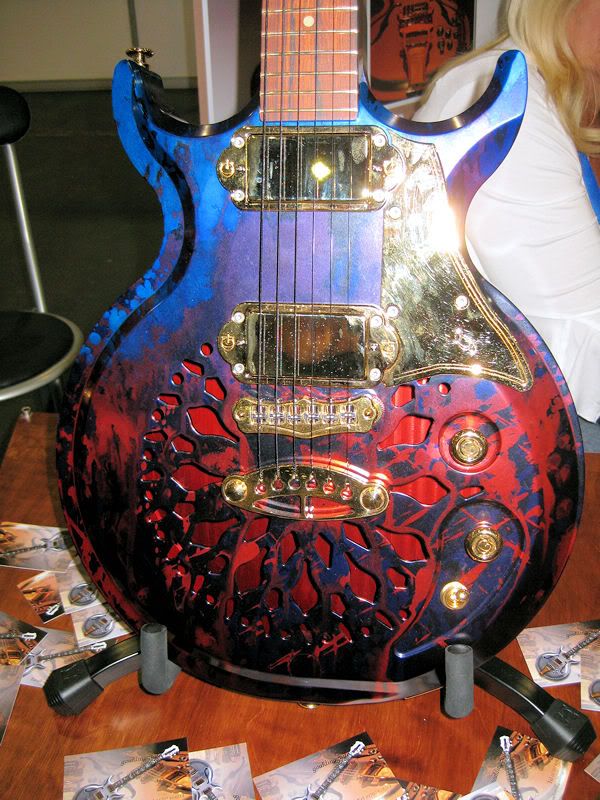
Some of the first guitars to catch my eye were these beautiful examples from Sparrow Guitars, many of which feature custom hand-painted finishes. These are some serious rock'n'roll machines and they have the looks to make sure you look great on stage.


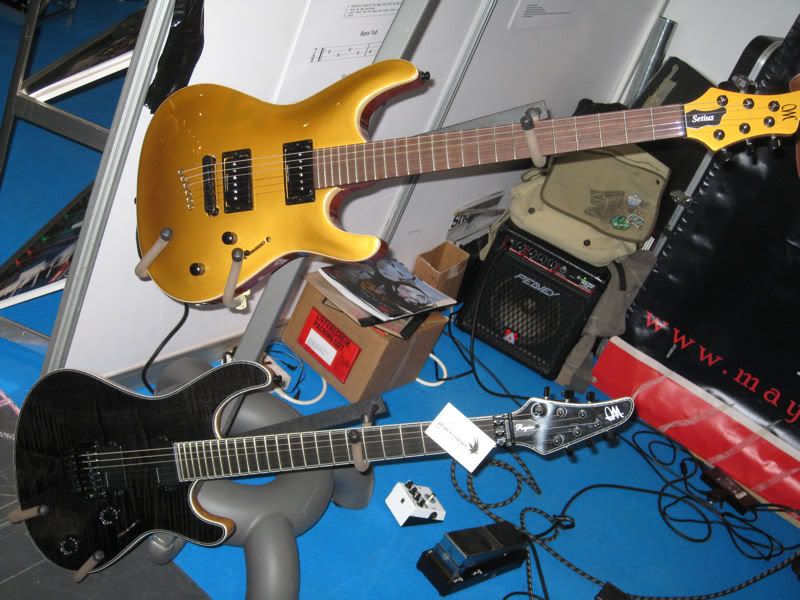
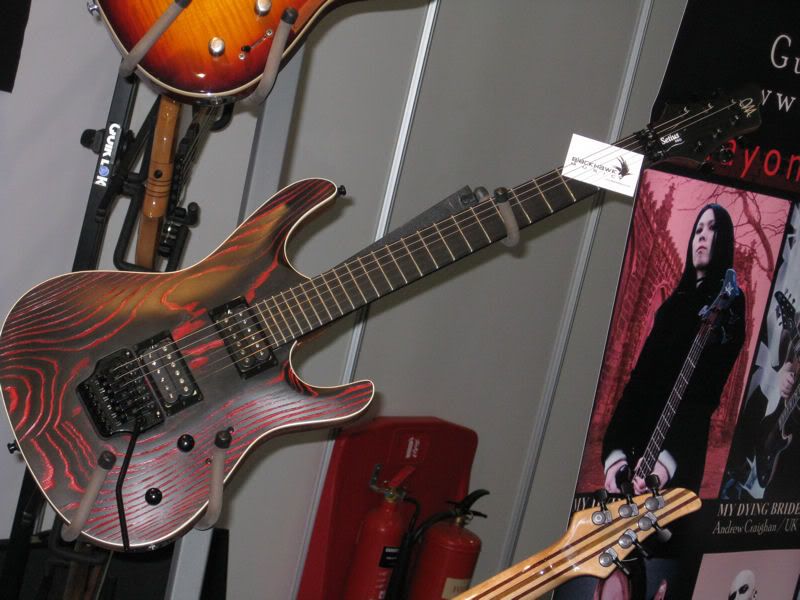
These rather attractive Mayones Guitars (below) were on display at the Blackhawk Music stand.


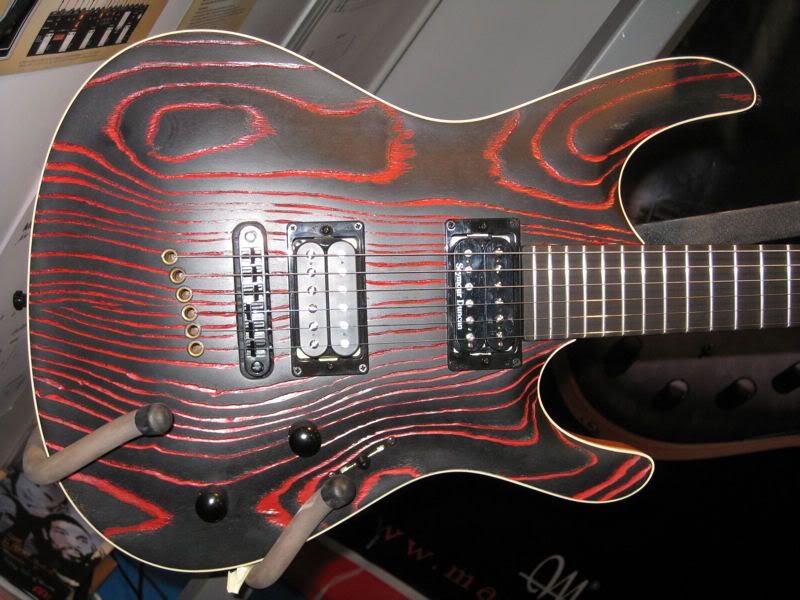
I particularly liked this finish (below) which I assume was created by sanding through the black finish to the red beneath. It's a lovely textured finish and is definitely quite eye-catching.


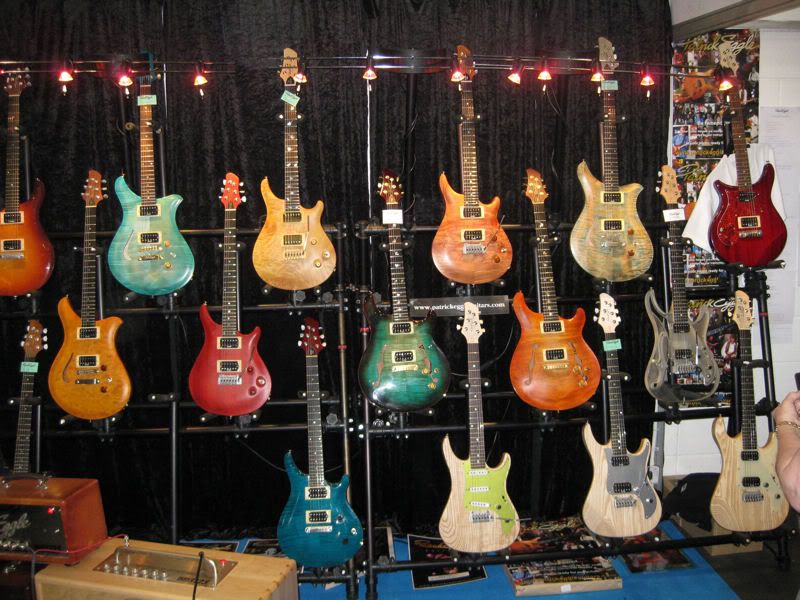
The Patrick Eggle stand. Fine guitars made in the UK.


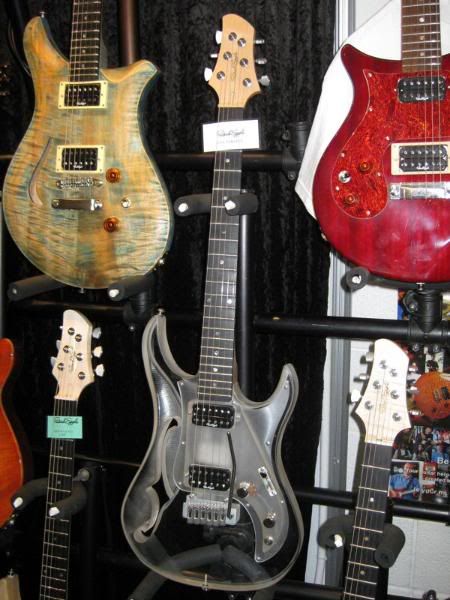
...and you know how I love perspex-bodied guitars. This Patrick Eggle example (below) isn't highly polished like acrylic guitars from most other manufacturers. The edges have been sanded to a rough matt surface that helps define the outline of the instrument. I also love the straight-through-the-body f-hole.


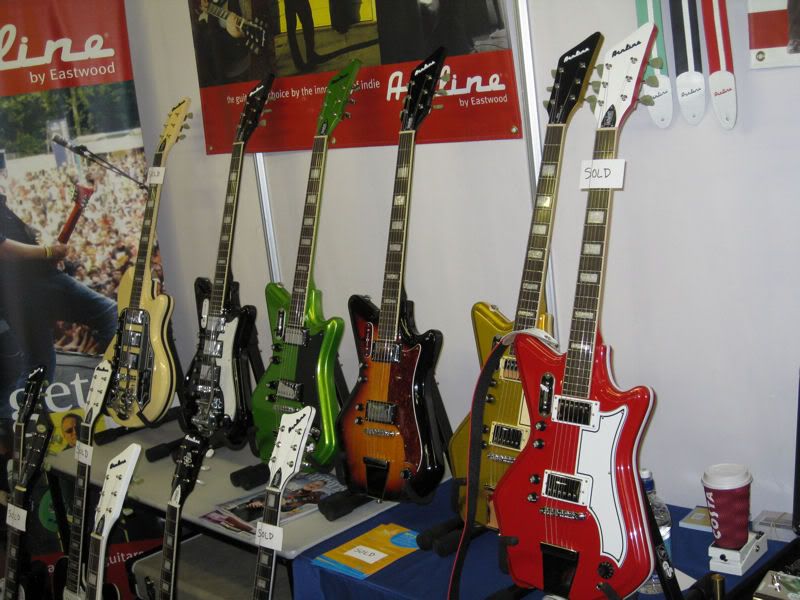
A whole heap of Airline guitars. It must be the...


...Eastwood Guitars stand.


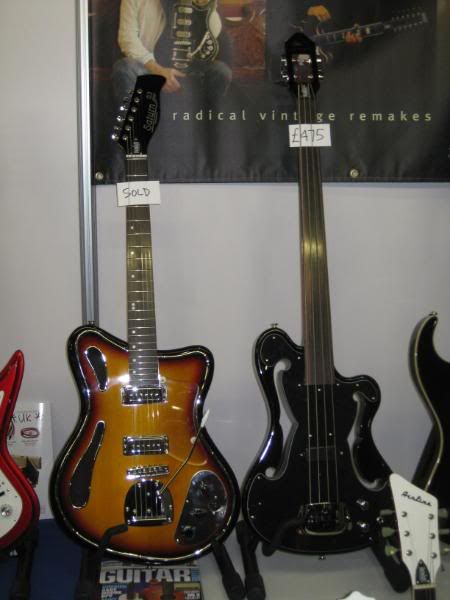
Ah, you know about Eastwood by now, surely? Retro-looking guitars but with modern playability, reliable hardware, good pickups, etc. They certainly look the part.

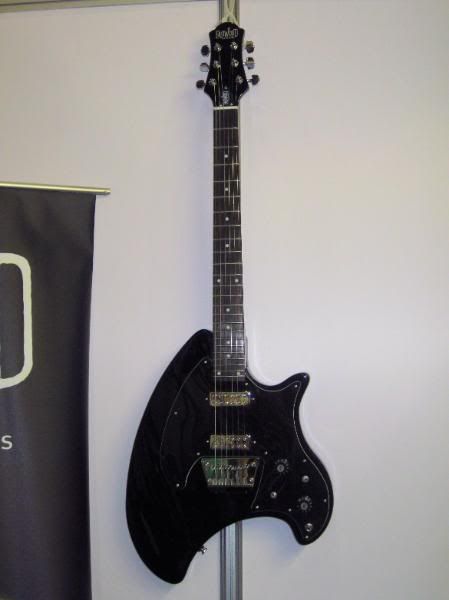
Pictured below is the one I really wanted to try. Regular readers will know that I'm a big fan of the Ovation Breadwinner, and I wanted to check out Eastwood's re-issue. So, I tried it out and you know what? It gets the thumbs up - it feels exactly like my 1976 Breadwinner - only newer and without the dents! Eastwood president Mike Robinson, who was on hand to talk about the guitars (what a thoroughly decent chap), tells me that the pickups are hotter than the originals, which I can well believe as that's one area where the Ovation originals are lacking.


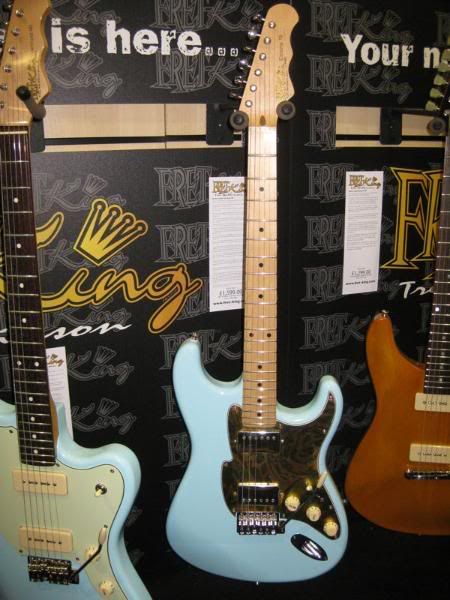
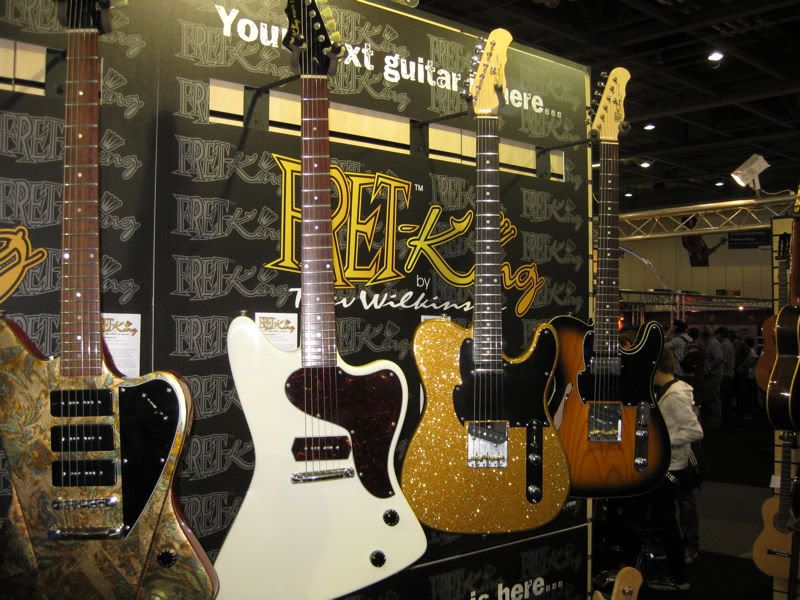
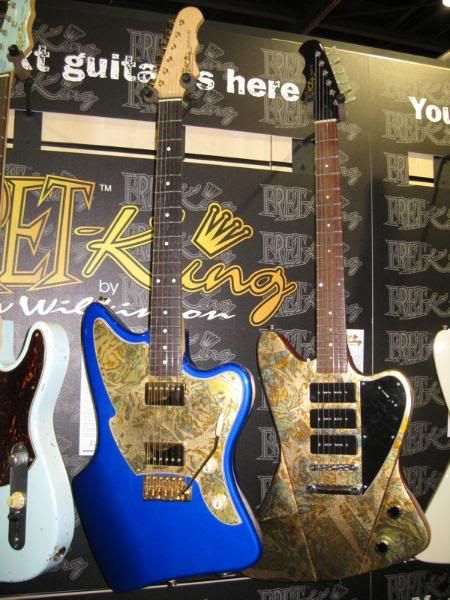
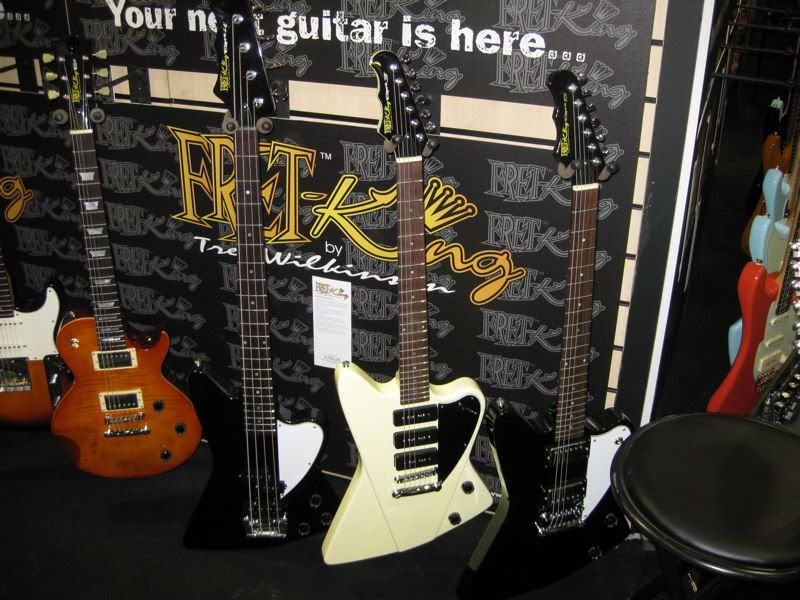
Fret King guitars are the baby of a guy you may have heard of by the name of Trev Wilkinson. These I do like. The influences are there to see on these vintage styles with a twist. They also have two ranges - the UK hand-built Green Label series, and more budget conscious Blue Label series featuring the same designs produced in Korea.


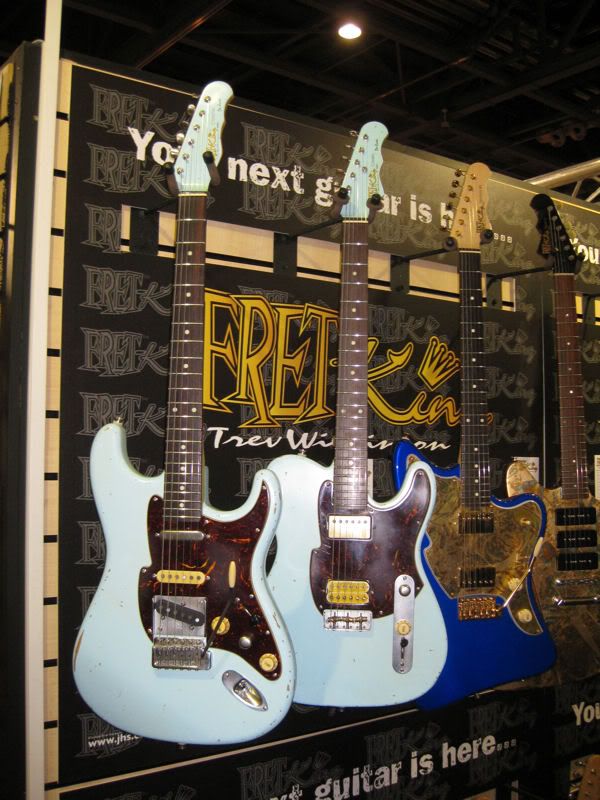
I'm not normally a fan of guitars with a "relic" or road-worn finish, but I did like this S and T-type pair from Fret King (below). I like the way the pickups and control knobs are deliberately mismatched, especially on the S-type guitar with has a nice mix of Strat and Tele features.

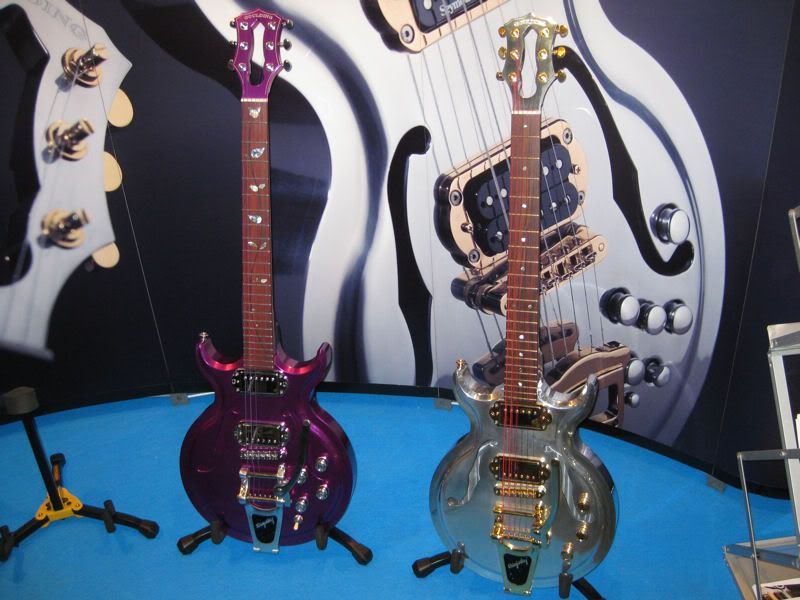
Now here's a sight to behold, these beautiful hand-built aluminium guitars from Goulding Guitars. Anthony Goulding, who builds these fine instruments, also makes all the hardware, the bridges, pickup surrounds and knobs. There are also many finish options: the purple example on the left in the below picture has been anodized, whilst the one on the right has a chrome finish.

Each guitar is custom-built to a customer's requirements, but all share the same basic shape. And what a great shape it is too! Anthony, who, it turns out,is a Guitarz reader (we had a good old chin wag) mentioned that I had once likened it to the shape of the Acoustic-branded Black Widow.

The guitar in the next picture takes design inspiration from the cut-out details on the cone covers of resonator guitars, although obviously this isn't a resonator. The finish is ... (what did you call it again? I should have made better notes...) splash anodized (?).


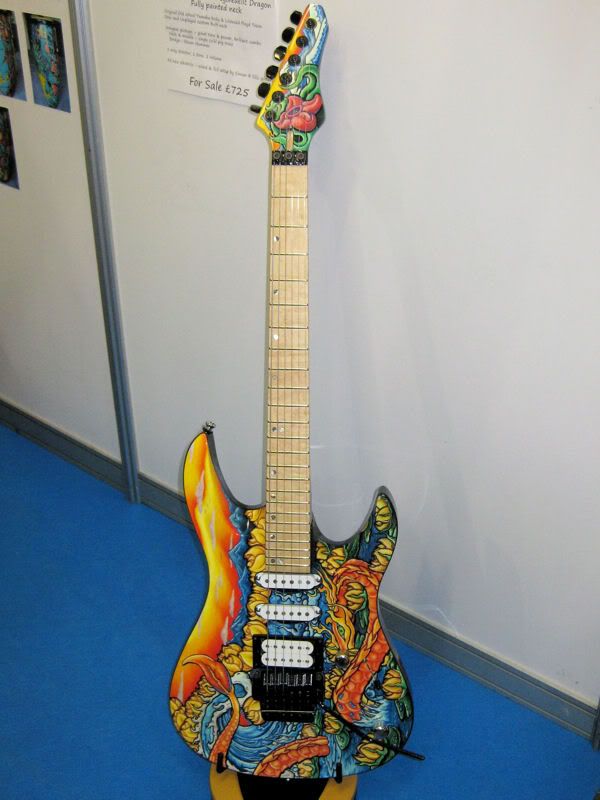
I had a great time talking to all the guys and girls on the booths. I also met Tom of Inky Hollow who creates custom artwork for guitars and basses, and seemingly any other instruments you care to throw his way such as drums, and also other items, e.g. motorbike helmets and surfboards. Check out the website because my photo here really does not do this particular example justice.


What else was there? Some of the big names were absent: Fender, Gibson, Rickenbacker... Did we miss them? No, not really.

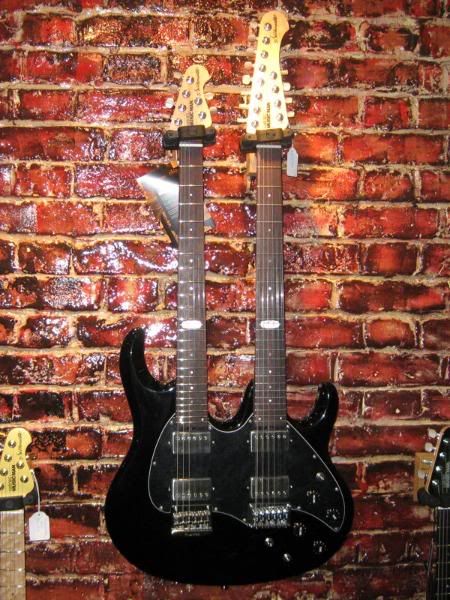
Music Man were present, as ever, on the Ernie Ball stand and this doubleneck caught my eye for a couple of reasons. For one, I was intrigued at the layout of tuners on the 12-string headstock, and also I thought that the body was quite nice and compact for a doubleneck which are often such cumbersome beasts.

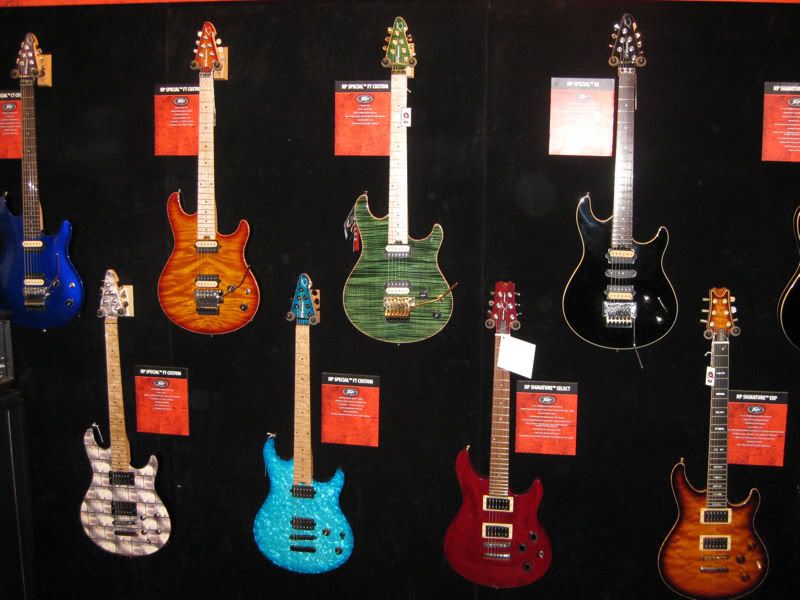
Peavey guitars (below):

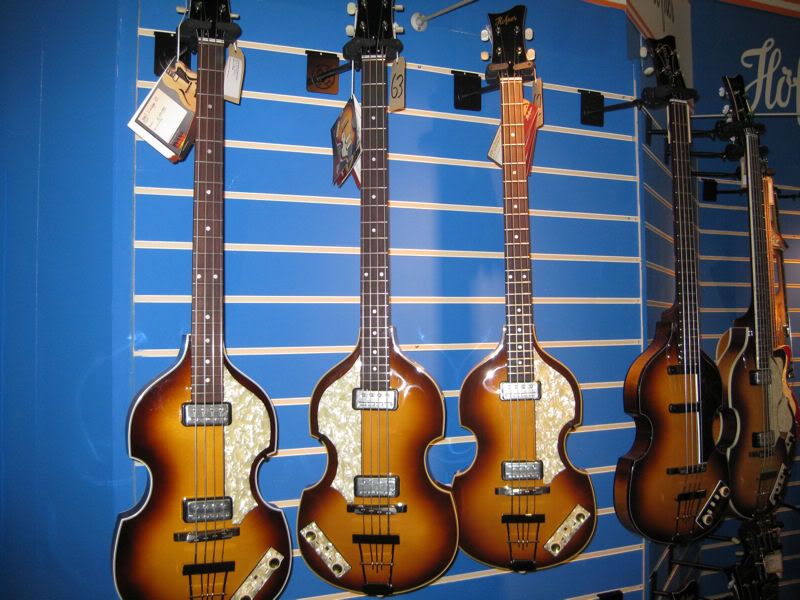
And then there was, a whole display of Paul McCartney-esque Hofner Violin Basses...


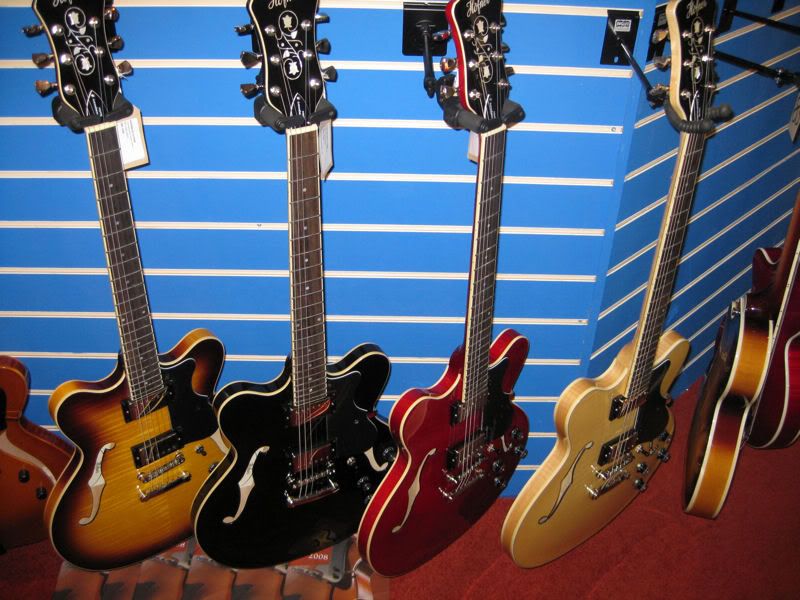
...and a whole rack of Hofner Verithin guitars. You can see where the name comes from. Very elegant looking, these.

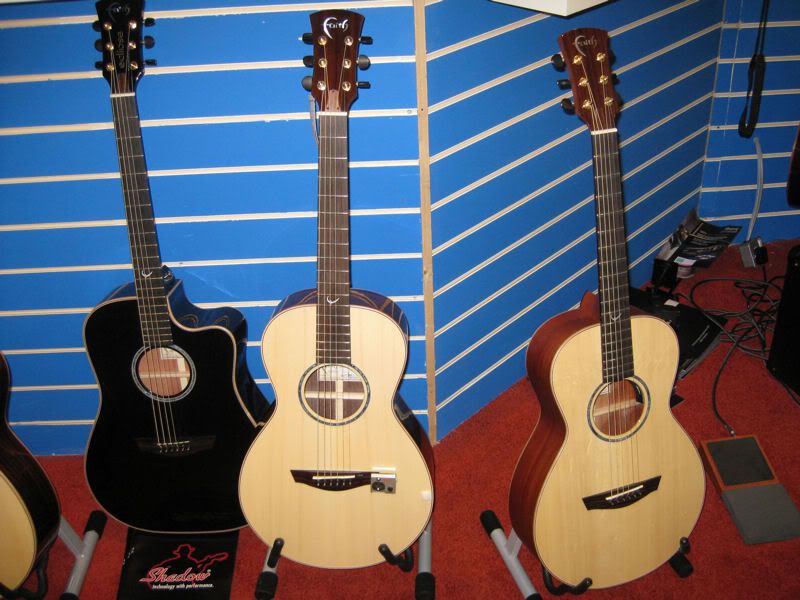
Now, I know nothing about these Faith acoustics (they were on the Shadow pickups stand) but I really liked the little 12-fret parlour guitar in the middle. I think this is what I want from an acoustic guitar, just for playing around the house.


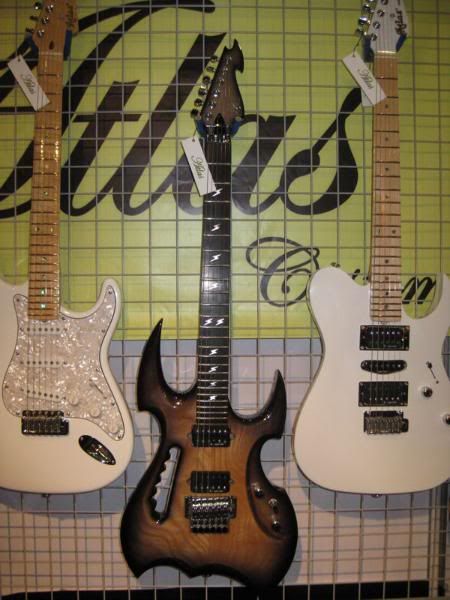
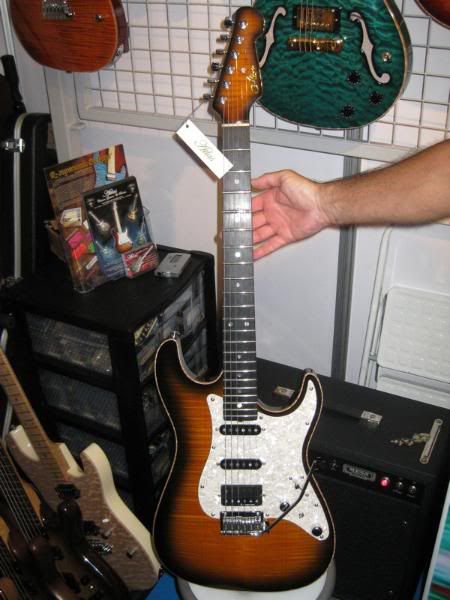
These Atlas guitars were quite beautifully made instruments...


... I especially liked their take on the classic Strat design with its bound-edge flamed top. Very tasty!


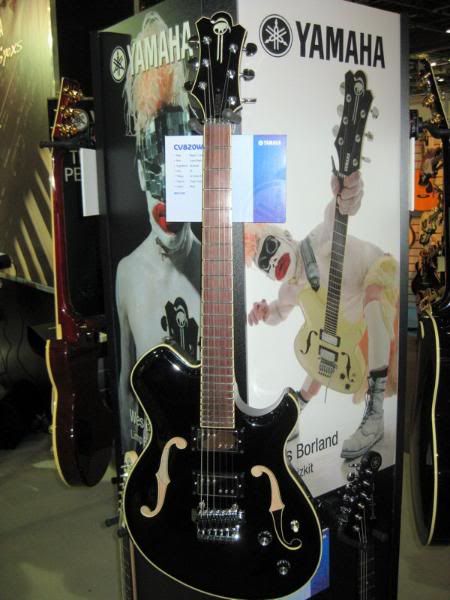
The only thing that caught my eye on the Yamaha stand was this retro-styled semi. Saying which is doing them a dis-service, as they do produce some quality gear.

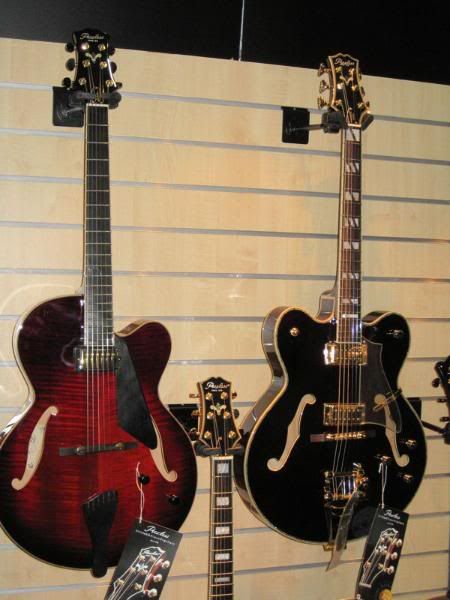
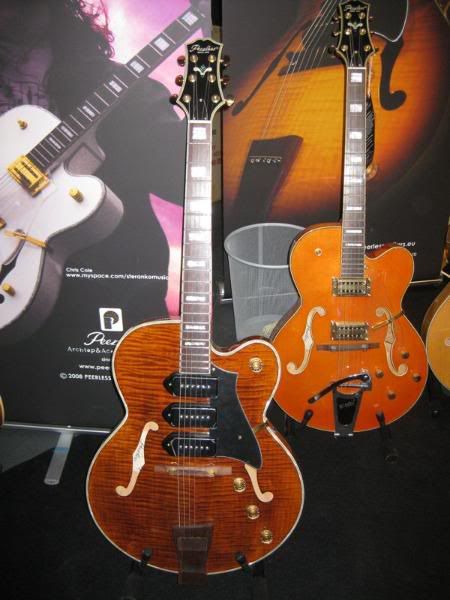
There were no Gretsch guitars to be seen (as part of the Fender empire, I guess they were absent for the same reasons as their parent company), but lovers of big-bodied archtop guitars would have been kept happy not only by Sparrow guitars as we have already seen, but also by these immaculate-looking Peerless guitars. These guys have been in the industry since 1970 and have built guitars for the likes of Gretsch, Fender and Gibson, so they ought to be well worth checking out in their own right.


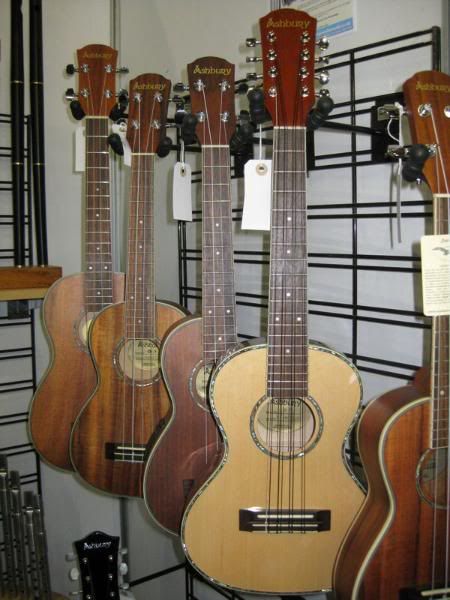
I liked this line of ukuleles from Ashbury, especially the 8-string tenor. It had a sound that was reminiscent of a mandolin.

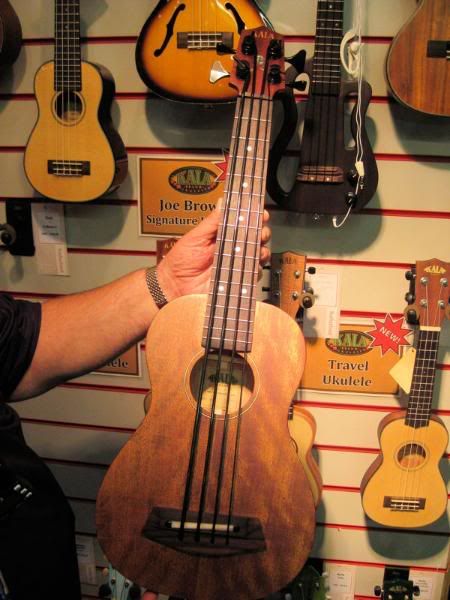
...and while we're talking of ukes, there was a fantastic selection over at the Sutherland Trading Co Ltd stand, including something I'd never seen before, a bass ukulele (the Kala uBass - pictured below). At first I thought it was a uke fitted with the silicon strings from a Ashbory bass, but I'm told these are actually polyurethane. What's more, it sounded great. It had a double bass quality to it. Very easy and fun to play - it's tuned just like a bass guitar - I really liked it.

Now before I finish, I want to put in writing here a couple of reminders for myself for next year.

  1. Check the dates carefully to avoid turning up a week early. (Yes, I did go last Saturday, to find no music show. Did I feel stupid or what?)
  2. Charge the batteries in your camera the night before.

Things I didn't manage to photograph included:

The XOX Audio Tools "The Handle" guitar on the PROEL (International) Ltd stand. What an absolutely beautiful guitar in terms of looks, sound and playabilty. Being made of hollow-sectioned carbon fibre it's as light as a feather. If only I had two and a half grand to spare...

Vintage Guitars - the brand "Vintage" from John Hornby Skewes, that is. Someone once commented on this blog that I had judged them too harshly and that they were pretty decent instruments, and that I should do my homework. Now, I'm always one to put my hand up when I'm wrong, so I thought I'd try out a couple. I tried a relic Strat-a-like from the Icon series. It was a little unsubstantial feeling for my tastes (for a Strat, that is), but it was certainly a very nice player, certainly better than many Squiers I have tried. I then tried an LP type guitar. I've never been a Les Paul player but I was almost sold. It played beautifully and it sounded great. Dare I say it even sounded authentic?
Dudley Ross, a very talented fretless guitar player was demonstrating the Vigier Excaliber guitar with delta-metal fingerboard, and which I featured in last year's report. He was very kindly letting people try out the guitar for themselves, including Yours Truly. What a beautiful player. I've experimented with fretless guitar in the past, but never imagined it could sound as good as this - even on the unwound strings (which was where my own customised fretless used to fall down).

I also noodled for a while on a Roland-equipped Fender Strat over at the Roland / Boss booth. It was plugged into a device called the Roland GR20 Guitar Synth. Most the sounds were pretty farty and perhaps someone had screwed up the settings as I could only really get it to track on the D and A strings. However, I discovered that I absolutely loved the Hammond organ patch, and spent ages playing Hammond solos (complete with Leslie rotating speaker effect) on two strings! It sounded very Steve Winwood.

And there - for now - I shall leave it. It's been a long day and I've been up all night typing this lot out and need bed! Until next year, then. (And we'll look at lots of curious guitars from eBay in the meantime!)

PLEASE NOTE: The photos in this article are all my own so if you do want to use one on a forum or a blog or whatever, that's fine, but please credit me and link back here. Thanks.