guitarz.blogspot.com:
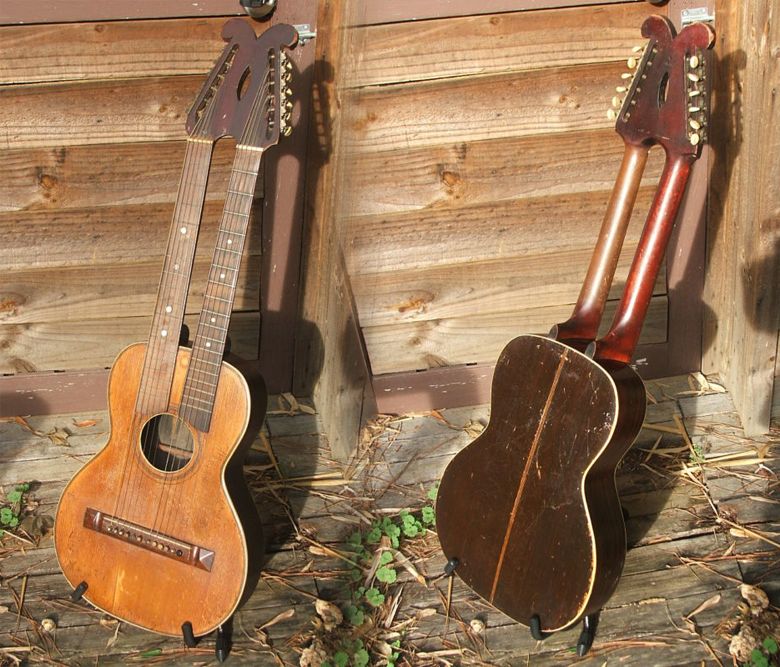
This Stella doubleneck harp guitar was made in Jersey City, New Jersey, in the 1920s by the Oscar Schmidt Company. Stella was the brand name used on the budget-priced line of instruments, but having found favour with many a blues musician over the years, the Stella brand is now highly collectable and vintage examples now sell for prices that are far from the "budget-priced" label.
It's also interesting to note that an instrument such as a harp guitar, which nowadays would be regarded as a highly specialised form of guitar, was in the early years of the 20th Century considered popular enough to warrant the existence of a budget line model.
Harp guitars come in many shapes and forms as even the briefest of glances through the fascinating www.harpguitars.net website will show you. This Stella example appears to be a double-necked guitar, but the contra-bass strings on the upper neck - which you'll notice has been left fretless - are only intended to be played as open strings. In fact, the necks are mounted too closely together to allow conventional playing on the upper neck, and this is another visual clue that the left hand is not required on the upper neck.
This guitar is currently listed on eBay with a Buy It Now price of $3,499.
G L Wilson
© 2011, Guitarz - The Original Guitar Blog - now in its 10th year!
Showing posts with label acoustic. Show all posts
Wednesday, November 9, 2011
Sunday, October 30, 2011
Vintage & Rare guitar of the week: Dommenget Maththias Jabs Acoustic Explorer
guitarz.blogspot.com:
This week our Guitar of the Week - chosen from the thousands of incredible instruments being sold via Vintage & Rare - is this quite stunning acoustic Explorer by Boris Dommenget as designed for Matthias Jabs of The Scorpions.
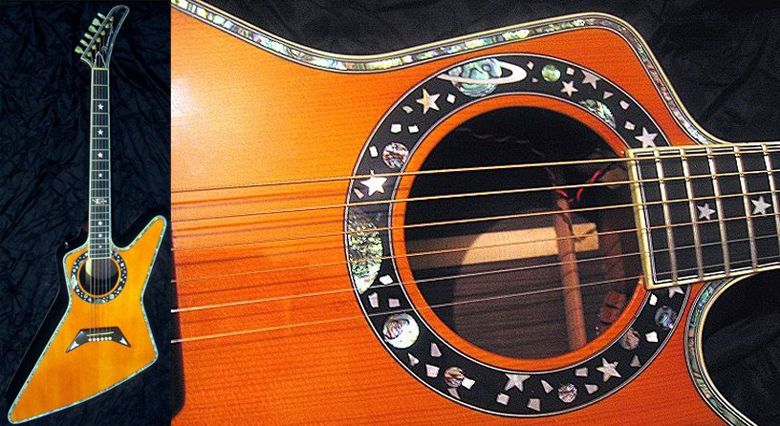
The guitar features a solid spruce top with back and sides of solid rosewood. Body binding on front and back is abalone and mother of pearl, and the intricate soundhole binding features stars and planets. The neck is Spanish cedar with ebony fretboard inlayed with star position markers. The headstock is the traditional Explorer shape and is fitted with Kluson tulip tuners. The scale length is a Fender-like 25.5" rather than the Gibson scale length of 24.75" that you might expect considering the design.
This guitar is being sold via Vintage & Rare priced at €7990.
Dommenget Guitars are based in Balje, Germany, and are best known for their various guitars built for German rock act The Scorpions. These have included acoustic Flying V guitars for Rudolf Schenker in 6-string, 12-string and doubleneck 12+6 models.
See also: Dommenget Guitars
G L Wilson
© 2011, Guitarz - The Original Guitar Blog - now in its 10th year!
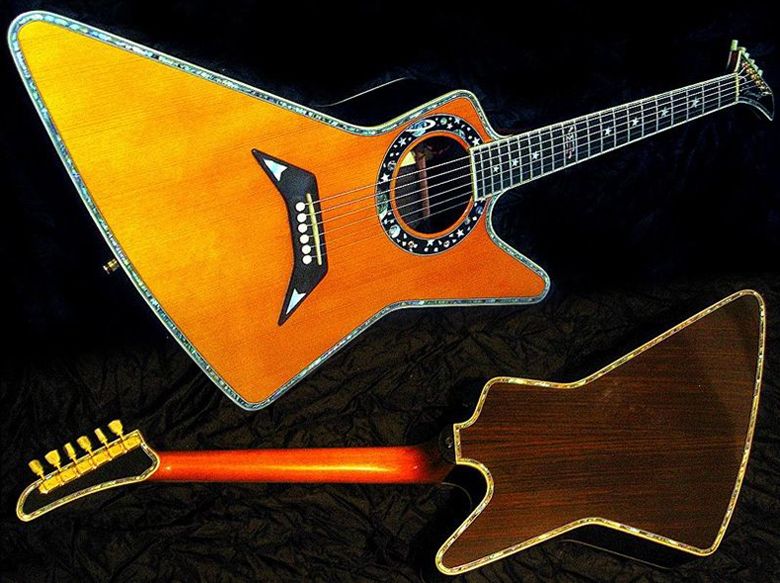
This week our Guitar of the Week - chosen from the thousands of incredible instruments being sold via Vintage & Rare - is this quite stunning acoustic Explorer by Boris Dommenget as designed for Matthias Jabs of The Scorpions.
The guitar features a solid spruce top with back and sides of solid rosewood. Body binding on front and back is abalone and mother of pearl, and the intricate soundhole binding features stars and planets. The neck is Spanish cedar with ebony fretboard inlayed with star position markers. The headstock is the traditional Explorer shape and is fitted with Kluson tulip tuners. The scale length is a Fender-like 25.5" rather than the Gibson scale length of 24.75" that you might expect considering the design.
This guitar is being sold via Vintage & Rare priced at €7990.
Dommenget Guitars are based in Balje, Germany, and are best known for their various guitars built for German rock act The Scorpions. These have included acoustic Flying V guitars for Rudolf Schenker in 6-string, 12-string and doubleneck 12+6 models.
See also: Dommenget Guitars
G L Wilson
© 2011, Guitarz - The Original Guitar Blog - now in its 10th year!
What guitar is Zaniboni playing in this video clip?
guitarz.blogspot.com:
Hey Tone! I reckon that's a Yamaha APX-T1, the travel-friendly model in Yamaha's acclaimed APX electro-acoustic series. Thanks for recommending the video; I enjoyed that! Maybe Bertram will be able to enlighten us as to what she's singing about.
G L Wilson
© 2011, Guitarz - The Original Guitar Blog - now in its 10th year!
Check out the guitar in this video.Zaniboni is a French singer. I love her guitar - so small and well-designed. A cute little acoustic. Plus she's a great singer and guitarist. I have no idea what she's singing! Thanks for the help!Tone Deaf Radio!
Hey Tone! I reckon that's a Yamaha APX-T1, the travel-friendly model in Yamaha's acclaimed APX electro-acoustic series. Thanks for recommending the video; I enjoyed that! Maybe Bertram will be able to enlighten us as to what she's singing about.
G L Wilson
© 2011, Guitarz - The Original Guitar Blog - now in its 10th year!
Friday, October 28, 2011
Antique vintage tenor guitar banjo uke banjitar - handmade and possibly unique?
guitarz.blogspot.com:
Here's another instrument that looks to be a handmade one-off, although a lot more craftsmanship has gone into creating this than on the boat oar guitar we saw in the previous blog post here on Guitarz.
I'm not sure what instrument the maker thought they were building here, but for our purposes I think it's safe to call it a cross between a tenor guitar, a tenor banjo and a baritone ukulele. The headstock style is very banjo-like, as is the general shape, but the all-wooden construction and soundhole are more guitar- and/or ukulele-like. The scale length is 21 1/2" which is more akin to a tenor guitar or banjo than it is to a baritone uke, but I guess it's up to the player to decide how to tune it and play it. I do like the hexangonal shape at the back of the body. If you've ever tried playing a banjo you'll know that a round body is not the best shape for playing when seated; I'm sure a hexagon-shaped instrument isn't going to slip as easily.
It does need some minor repair work doing to it, but with a starting price of $0.99 on eBay it could provide a nice little project for someone which is unlikely to break the bank.
G L Wilson
© 2011, Guitarz - The Original Guitar Blog - now in its 10th year!
Here's another instrument that looks to be a handmade one-off, although a lot more craftsmanship has gone into creating this than on the boat oar guitar we saw in the previous blog post here on Guitarz.
I'm not sure what instrument the maker thought they were building here, but for our purposes I think it's safe to call it a cross between a tenor guitar, a tenor banjo and a baritone ukulele. The headstock style is very banjo-like, as is the general shape, but the all-wooden construction and soundhole are more guitar- and/or ukulele-like. The scale length is 21 1/2" which is more akin to a tenor guitar or banjo than it is to a baritone uke, but I guess it's up to the player to decide how to tune it and play it. I do like the hexangonal shape at the back of the body. If you've ever tried playing a banjo you'll know that a round body is not the best shape for playing when seated; I'm sure a hexagon-shaped instrument isn't going to slip as easily.
It does need some minor repair work doing to it, but with a starting price of $0.99 on eBay it could provide a nice little project for someone which is unlikely to break the bank.
G L Wilson
© 2011, Guitarz - The Original Guitar Blog - now in its 10th year!
Thursday, October 27, 2011
BC Rich NJ Series Made In Japan electro-acoustic jazz guitar
guitarz.blogspot.com:
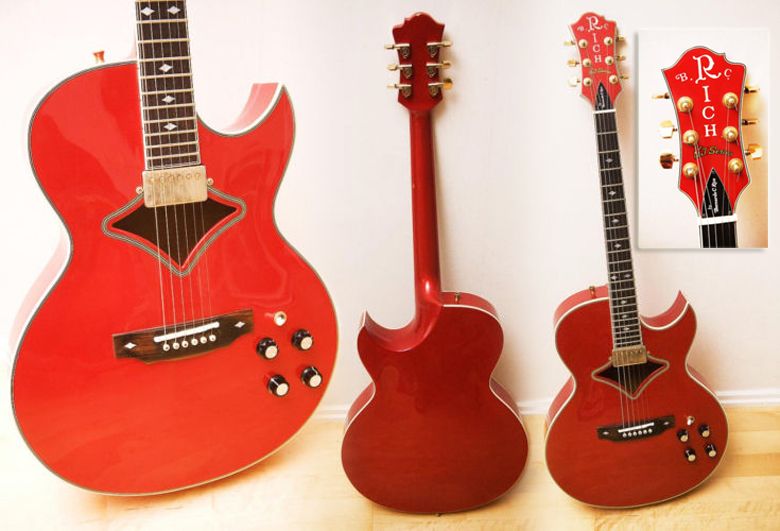
B.C. Rich's NJ Series replaced the B.C. Rico brandname that originally appeared on their Japanese-made instruments and which had been the subject of a lawsuit from the Rico Reed Company. Although the initials NJ stood for "Nagoya, Japan" where the first NJ instruments were built, later Korean-made guitars also received the NJ Series designation.
This B.C. Rich NJ Series electro-acoustic jazzer, reminiscent in some ways of Gibson's Howard Roberts model, is a Japanese-made example which the seller claims was made by the Daion company. (Check here for other Daion guitars that we have looked at previously here on Guitarz). Daion guitars were manufactured from the lates 1970s through to 1984 by the Japanese company Yamaki, so I guess that it was this same company who built these B.C. Rich models rather than Daion specifically.
The guitar features a humbucker pickup at the neck plus a piezo in the bridge, controlled via volume and tone pots for each and a 3-way pickup selector switch all boldy mounted on top of the guitar. The soundhole is a suitably angular shape considering the brand, as is the sharp Florentine cutaway. The heel of the neck is comfort contoured so as to facilitate playing at the top of the neck.
This guitar is currently being offered for same on eBay UK (although the item is actually located in Sweden) with a starting price of £599.99 and a Buy It Now price of £999.99.
G L Wilson
© 2011, Guitarz - The Original Guitar Blog - now in its 10th year!
B.C. Rich's NJ Series replaced the B.C. Rico brandname that originally appeared on their Japanese-made instruments and which had been the subject of a lawsuit from the Rico Reed Company. Although the initials NJ stood for "Nagoya, Japan" where the first NJ instruments were built, later Korean-made guitars also received the NJ Series designation.
This B.C. Rich NJ Series electro-acoustic jazzer, reminiscent in some ways of Gibson's Howard Roberts model, is a Japanese-made example which the seller claims was made by the Daion company. (Check here for other Daion guitars that we have looked at previously here on Guitarz). Daion guitars were manufactured from the lates 1970s through to 1984 by the Japanese company Yamaki, so I guess that it was this same company who built these B.C. Rich models rather than Daion specifically.
The guitar features a humbucker pickup at the neck plus a piezo in the bridge, controlled via volume and tone pots for each and a 3-way pickup selector switch all boldy mounted on top of the guitar. The soundhole is a suitably angular shape considering the brand, as is the sharp Florentine cutaway. The heel of the neck is comfort contoured so as to facilitate playing at the top of the neck.
This guitar is currently being offered for same on eBay UK (although the item is actually located in Sweden) with a starting price of £599.99 and a Buy It Now price of £999.99.
G L Wilson
© 2011, Guitarz - The Original Guitar Blog - now in its 10th year!
Wednesday, October 26, 2011
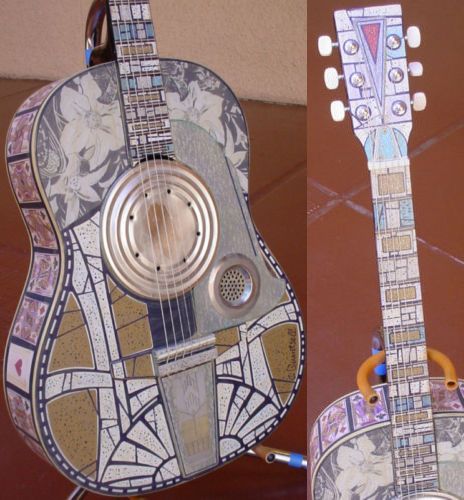
So-called Art Deco resonator guitar with over-the-top finish and baked bean can detail
guitarz.blogspot.com:
There's no denying that the artwork on this old acoustic guitar (a so-called "Customised Resonator Guitar" even) has been beautifully executed. It is supposedly Art Deco inspired, although I think it is rather too busy to fit in faithfully with that genre. The playing cards around the sides of the guitar are really one step too far and lend it a tacky Las Vegas look rather than one of sophistication which I believe was the desired effect.
What really spoils it is the base from a catering-size tin of baked beans that has been inset where the soundhole once inoffensively appeared. I usually try not to sink to lowest common denominators when describing guitars like this, but in this instance all I can think to say is that it looks crap. Pairing this with a second soundhole insert, quite obviously a strainer intended to sit over the plughole in the kitchen sink, does nothing to help matters. Yes, by all means use these elements on cigar box guitars; they seem to make some sense there and indeed are part of the charm of such instruments. But on an instrument that is trying to look sophisticated, such elements could not be more out of place.
Furthermore, shoving the bottom of a baked bean tin into the top of your guitar will not magically transform it into a resonator. The spun aluminium cone of a resonator guitar is a fine piece of precision engineering. Its function cannot be replicated with the bottom of a bean tin with a few holes punched in it. All that is going to do is to create a few more spurious vibrations and cause the guitar to rattle.
You might consider this a nice example of a piece of folk art and that the Buy It Now price of £270 would be money well spent, but personally I'd give it a miss. If it does actually sound any good, it'll be by accident rather than design. Note that in the YouTube video showing the guitar, the video finishes just before the guitar is about to get played. That alone speaks volumes!
G L Wilson
© 2011, Guitarz - The Original Guitar Blog - now in its 10th year!
There's no denying that the artwork on this old acoustic guitar (a so-called "Customised Resonator Guitar" even) has been beautifully executed. It is supposedly Art Deco inspired, although I think it is rather too busy to fit in faithfully with that genre. The playing cards around the sides of the guitar are really one step too far and lend it a tacky Las Vegas look rather than one of sophistication which I believe was the desired effect.
What really spoils it is the base from a catering-size tin of baked beans that has been inset where the soundhole once inoffensively appeared. I usually try not to sink to lowest common denominators when describing guitars like this, but in this instance all I can think to say is that it looks crap. Pairing this with a second soundhole insert, quite obviously a strainer intended to sit over the plughole in the kitchen sink, does nothing to help matters. Yes, by all means use these elements on cigar box guitars; they seem to make some sense there and indeed are part of the charm of such instruments. But on an instrument that is trying to look sophisticated, such elements could not be more out of place.
Furthermore, shoving the bottom of a baked bean tin into the top of your guitar will not magically transform it into a resonator. The spun aluminium cone of a resonator guitar is a fine piece of precision engineering. Its function cannot be replicated with the bottom of a bean tin with a few holes punched in it. All that is going to do is to create a few more spurious vibrations and cause the guitar to rattle.
You might consider this a nice example of a piece of folk art and that the Buy It Now price of £270 would be money well spent, but personally I'd give it a miss. If it does actually sound any good, it'll be by accident rather than design. Note that in the YouTube video showing the guitar, the video finishes just before the guitar is about to get played. That alone speaks volumes!
© 2011, Guitarz - The Original Guitar Blog - now in its 10th year!
Monday, October 17, 2011
Vintage & Rare guitar of the week: Prohaszka Silver Sparkle flat-top acoustic
guitarz.blogspot.com:
Balazs Prohaszka is a luthier from Hungary who has been building musical instruments since 1994. He has much experience of repairing and building guitars, violins, lutes and double basses so he surely knows his way around the anatomy of acoustic instruments. Prohaszka's fine guitars are made from exotic and choice tonal woods, and he believes that they are amongst the finest in the world. Employed as a senior craftsman with N. Ireland's Avalon Guitars (formerly Lowden Guitars), he builds approximately six or seven "personal" guitars in his own name each year during his spare time.
This Prohaszka silver-sparkle fronted flat-top acoustic guitar is currently being offered for sale via Vintage & Rare and is priced at £2600.00 (approx. €3101.00). The guitar has an original design that should find favour with electric players whilst still retaining the full acoustic body depth. I particularly like the "split" f-hole and the cut-out 6-in-a-line headstock which is quite elegant.
It's an instrument that you can imagine being played in the hands of the singer of a glitzy rock band. However, it might be considered sacrilege to subject a fine luthier-built instrument like this to the rock 'n' roll lifestyle where perhaps some cheaper generic electro-acoustic guitars would be better suited to the role. (Having said that, it doesn't look as if the Prohaszka Sparkle is actually fitted with any electronics, despite the design. I believe it is purely an acoustic guitar.)
G L Wilson
© 2011, Guitarz - The Original Guitar Blog - now in its 10th year!
Balazs Prohaszka is a luthier from Hungary who has been building musical instruments since 1994. He has much experience of repairing and building guitars, violins, lutes and double basses so he surely knows his way around the anatomy of acoustic instruments. Prohaszka's fine guitars are made from exotic and choice tonal woods, and he believes that they are amongst the finest in the world. Employed as a senior craftsman with N. Ireland's Avalon Guitars (formerly Lowden Guitars), he builds approximately six or seven "personal" guitars in his own name each year during his spare time.
This Prohaszka silver-sparkle fronted flat-top acoustic guitar is currently being offered for sale via Vintage & Rare and is priced at £2600.00 (approx. €3101.00). The guitar has an original design that should find favour with electric players whilst still retaining the full acoustic body depth. I particularly like the "split" f-hole and the cut-out 6-in-a-line headstock which is quite elegant.
It's an instrument that you can imagine being played in the hands of the singer of a glitzy rock band. However, it might be considered sacrilege to subject a fine luthier-built instrument like this to the rock 'n' roll lifestyle where perhaps some cheaper generic electro-acoustic guitars would be better suited to the role. (Having said that, it doesn't look as if the Prohaszka Sparkle is actually fitted with any electronics, despite the design. I believe it is purely an acoustic guitar.)
G L Wilson
© 2011, Guitarz - The Original Guitar Blog - now in its 10th year!
Saturday, October 15, 2011
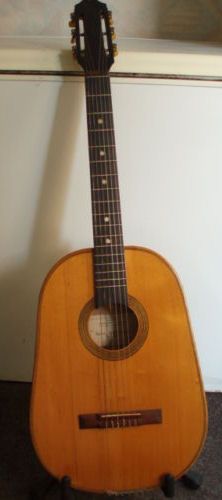
Pre-war, French-made "Pineapple" guitar
guitarz.blogspot.com:
I'm afraid I have virtually zero information to give you about this French pineapple guitar other than it looks to be a nylon strng instrument (although it originally had a trapeze tailpiece which would imply folk guitar rather than classical guitar) and is supposedly pre-war French (2nd World War, I believe).
Its shape echoes that of the pineapple ukulele. I've not seen a pineapple-shaped guitar before, although we have previously looked at an egg-shaped acoustic guitar.
This guitar does require some attention and as such is being auctioned on eBay UK as a project with a starting price of £50.
G L Wilson
Additional: We believe it is a Hawaiian guitar - see the comments below this post.
© 2011, Guitarz - The Original Guitar Blog - now in its 10th year!
I'm afraid I have virtually zero information to give you about this French pineapple guitar other than it looks to be a nylon strng instrument (although it originally had a trapeze tailpiece which would imply folk guitar rather than classical guitar) and is supposedly pre-war French (2nd World War, I believe).
Its shape echoes that of the pineapple ukulele. I've not seen a pineapple-shaped guitar before, although we have previously looked at an egg-shaped acoustic guitar.
This guitar does require some attention and as such is being auctioned on eBay UK as a project with a starting price of £50.
G L Wilson
Additional: We believe it is a Hawaiian guitar - see the comments below this post.
© 2011, Guitarz - The Original Guitar Blog - now in its 10th year!
Sunday, October 9, 2011
Osbama Tango acoustic guitar
The Osbama brand stands for Oswald Bachmann Markneukirchen - Markneukirchen being this town in Saxony (next to the Czech border) famous for its music industry since the late 17th century. Situated in GDR after the WWII, it is where many of these electric guitars we enjoy so much have been conceived and built, and many East-German brands you are familiar with included its first syllable in their names - Musima, Migma, Marma...
The Osbama Tango was a very successful model at the time, combining traditional music quality and art-deco design - the lightning sound holes are particularly bold and elegant. Like often, its lines are more dynamic and elegant that it equivalent from West-Germany, with which it still shares the inevitable German carve and blonde finish.
An interesting fact - that might explain why it is sometimes so difficult to gather information - is that these guitars were usually not branded to ease their distribution in the black market. Both in the east and the west, post-war Germany was avid of entertainment, and musicians were often retributed with black market goods from occupation armies, including instruments, and a good Markneukirchen guitar was appreciated in the west, though it was better if it was untraceable...
Bertram An interesting fact - that might explain why it is sometimes so difficult to gather information - is that these guitars were usually not branded to ease their distribution in the black market. Both in the east and the west, post-war Germany was avid of entertainment, and musicians were often retributed with black market goods from occupation armies, including instruments, and a good Markneukirchen guitar was appreciated in the west, though it was better if it was untraceable...
© 2011, Guitarz - The Original Guitar Blog - now in its 10th year!
Car
Tango Osbama
Sunday, October 2, 2011
Maccaferri TV Pal 1950s plastic acoustic guitar
guitarz.blogspot.com:
Way before this modern age of MP3s and digital downloads, before CDs even, we listened to music on records or "vinyl" as it is called now. I remember back in the late 1970s following the advent of punk rock and new wave, the music was much spikier and the records themselves were often pressed in various shades of coloured vinyl rather than the usual black. I recall in the music press there was a big noise when it was announced that the new Generation X single, "Valley of the Dolls", was to be issued in multicoloured vinyl. Of course when the record came out, the colour was a sludgy swirl of brown. As any kid that has played with Plasticine modelling clay could have told us, if you mix a whole bunch of colours together you end up with brown with little swirls of colour in it.
Which is a very roundabout way of saying that I think that may the same thing must have happened with this plastic Maccaferri TV Pal guitar. It was probably intended to be multi-coloured but ended up a brown swirly mess.
Mario Maccaferri was, of course, best known for the Selmer gypsy jazz guitar he designed. He also had a career in the production of plastic consumer goods. Believing that plastic had a previously untapped potential he produced the world's first plastic stringed instrument, the Islander plastic ukulele in 1948. By 1953 he had branched out into the production of plastic guitars. These were not intended solely as novelty items; they were supposed to be serious highly functional instruments. The TV Pal model was one of the round-hole designs which also included the Islander and Romancer guitars, but possibly the Maccaferri plastic gypsy jazz guitar with cutaway and f-holes is better known.
This Macaferri TV Pal is currently listed on eBay with a Buy It Now price of $195.
G L Wilson
© 2011, Guitarz - The Original Guitar Blog - now in its 10th year!
Way before this modern age of MP3s and digital downloads, before CDs even, we listened to music on records or "vinyl" as it is called now. I remember back in the late 1970s following the advent of punk rock and new wave, the music was much spikier and the records themselves were often pressed in various shades of coloured vinyl rather than the usual black. I recall in the music press there was a big noise when it was announced that the new Generation X single, "Valley of the Dolls", was to be issued in multicoloured vinyl. Of course when the record came out, the colour was a sludgy swirl of brown. As any kid that has played with Plasticine modelling clay could have told us, if you mix a whole bunch of colours together you end up with brown with little swirls of colour in it.
Which is a very roundabout way of saying that I think that may the same thing must have happened with this plastic Maccaferri TV Pal guitar. It was probably intended to be multi-coloured but ended up a brown swirly mess.
Mario Maccaferri was, of course, best known for the Selmer gypsy jazz guitar he designed. He also had a career in the production of plastic consumer goods. Believing that plastic had a previously untapped potential he produced the world's first plastic stringed instrument, the Islander plastic ukulele in 1948. By 1953 he had branched out into the production of plastic guitars. These were not intended solely as novelty items; they were supposed to be serious highly functional instruments. The TV Pal model was one of the round-hole designs which also included the Islander and Romancer guitars, but possibly the Maccaferri plastic gypsy jazz guitar with cutaway and f-holes is better known.
This Macaferri TV Pal is currently listed on eBay with a Buy It Now price of $195.
G L Wilson
© 2011, Guitarz - The Original Guitar Blog - now in its 10th year!
Friday, September 23, 2011
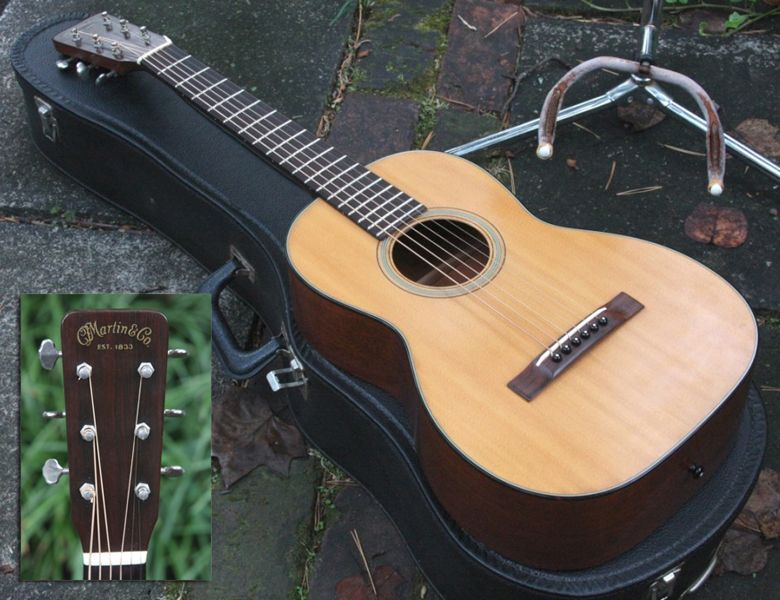
Martin 5-16 Terz Guitar - vintage short-scale acoustic from 1962
guitarz.blogspot.com:
On first sighting I thought that this diminutive Martin 5-16 from 1962 was a parlour guitar, but apparently it is a Terz guitar. Seeing as the seller refers to the "low E" string and the strings pictured on the guitar are obviously a heavy set, I suspect that this example doesn't use the correct Terz guitar tuning.
The Terz guitar, popular in the 19th Century, is a short scale guitar pitched at a minor third higher than a regular guitar, giving it a clear tone that carries well. Originally, Terz guitars were unlikely to have been used as solo instruments, rather they were a component in ensembles and guitar duos, etc. The Italian composer Mauro Giuliani, guitar virtuoso of the early 1900s, composed extensively for the Terz guitar as a compliment to the prime guitar.
This Martin 5-16 is in stunning "time capsule" condition for an instrument nearly 50 years old and is currently listed on eBay with a Buy It Now price of $2,750.
G L Wilson
© 2011, Guitarz - The Original Guitar Blog - now in its 10th year!
On first sighting I thought that this diminutive Martin 5-16 from 1962 was a parlour guitar, but apparently it is a Terz guitar. Seeing as the seller refers to the "low E" string and the strings pictured on the guitar are obviously a heavy set, I suspect that this example doesn't use the correct Terz guitar tuning.
The Terz guitar, popular in the 19th Century, is a short scale guitar pitched at a minor third higher than a regular guitar, giving it a clear tone that carries well. Originally, Terz guitars were unlikely to have been used as solo instruments, rather they were a component in ensembles and guitar duos, etc. The Italian composer Mauro Giuliani, guitar virtuoso of the early 1900s, composed extensively for the Terz guitar as a compliment to the prime guitar.
This Martin 5-16 is in stunning "time capsule" condition for an instrument nearly 50 years old and is currently listed on eBay with a Buy It Now price of $2,750.
G L Wilson
© 2011, Guitarz - The Original Guitar Blog - now in its 10th year!
Tuesday, September 20, 2011
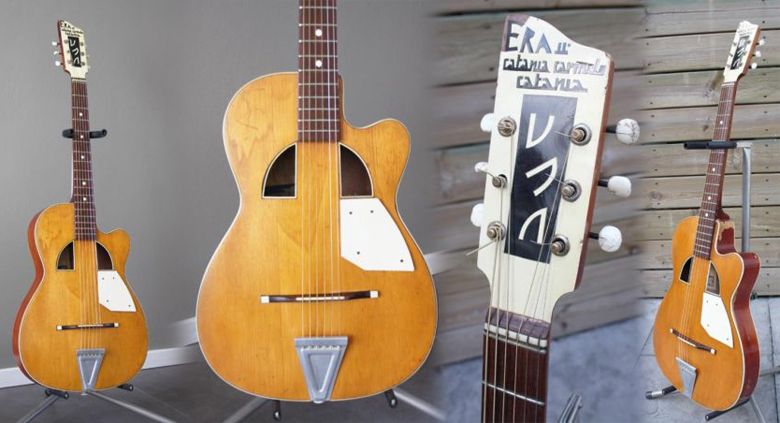
Carmelo Catania Era II vintage jazz guitar from Sicily
guitarz.blogspot.com:
For me there is nothing worse design-wise on an acoustic guitar than weird soundholes that just don't work aesthetically. A number of modern guitars have soundholes of different shapes placed in various different positions - no doubt for tonal properties rather than for aesthetics - but often I just think how dreadful they look.
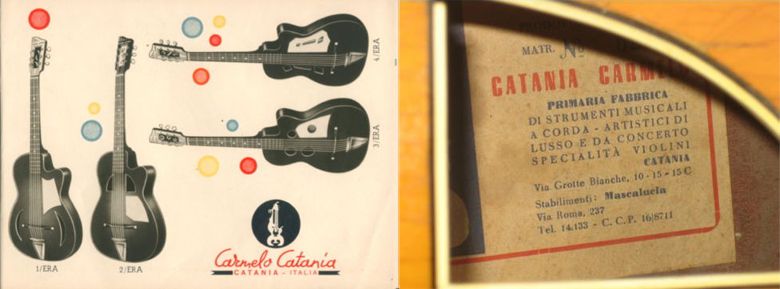
I do however, quite like this design on this 1950s Carmelo Catania Era II. It seems so weird to see an archtop jazz guitar with anything but f-holes, but look at the photo from Carmelo Catania's catalogue (below) and you'll see that their basic jazz guitar was offered in four versions each with different soundhole designs.
The eBay seller tells us this about Carmelo Catania:
G L Wilson
© 2011, Guitarz - The Original Guitar Blog - now in its 10th year!
For me there is nothing worse design-wise on an acoustic guitar than weird soundholes that just don't work aesthetically. A number of modern guitars have soundholes of different shapes placed in various different positions - no doubt for tonal properties rather than for aesthetics - but often I just think how dreadful they look.
I do however, quite like this design on this 1950s Carmelo Catania Era II. It seems so weird to see an archtop jazz guitar with anything but f-holes, but look at the photo from Carmelo Catania's catalogue (below) and you'll see that their basic jazz guitar was offered in four versions each with different soundhole designs.
The eBay seller tells us this about Carmelo Catania:
Throughout the 900 Sicily was one of the most relevant production centres of musical instrument together with The Marches and Lombardy. Set so far away from the high standards of the arch instruments made in Cremona and from the quality of the Neapolitan mandolins, Sicily was quickly renown as the land of luthiers. Curiously, all Sicilian luthiers were born in Catania, at the feet of Etna, the volcano.Currently listed on eBay UK with a starting price of £350 and Buy It Now price of $675.
The poor economy of the region highly contributed to the huge migrant wave in the 20s towards France that gave birth to an extraordinary school of French luthiery. The luthiers from Catania are to be mentioned: Pappalardo, Di Mauro, Amico, Anastasio, Busato, Bucolo, Castelluccia, Favino, Olivieri, Burgassi, Martella, Grizzo, Rossito, Petillo...among many others.
Luthiers in Sicily were always open to both the Baroque influence from Spain and to the innovations coming from Europe and The States. The first great star among Sicilian luthiers was surely Carmelo Catania who was the only one to understand that the image of the luthier had to become more of a businessman to survive on the internal and international market. Carmelo Catania’s golden age was from the end of the war to the 60s. The cultural and economic situation brought Carmelo Catania to produce an incredible wide range of crafted instruments on industrial scale. The few pages of his catalogue here reported show his skills in bringing together all the different external influences in a typically Sicilian sensitivity. Carmelo Catania was probably the first luthier to organize himself industrially, promoting himself, exporting guitars, settling commercial alleys and trades. He created a real production headquarter in Sicily making instruments or parts on behalf of third parties.
G L Wilson
© 2011, Guitarz - The Original Guitar Blog - now in its 10th year!
Monday, September 19, 2011
British-made Windsor Whirle tenor guitar - or is it a baritone ukulele?
guitarz.blogspot.com:
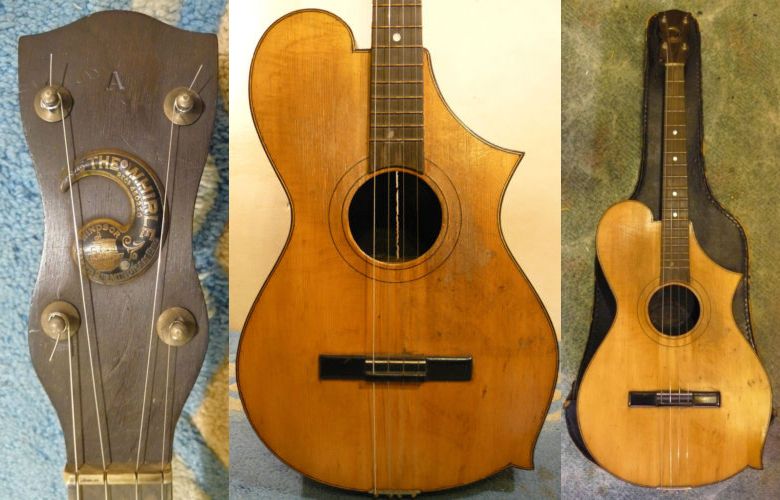
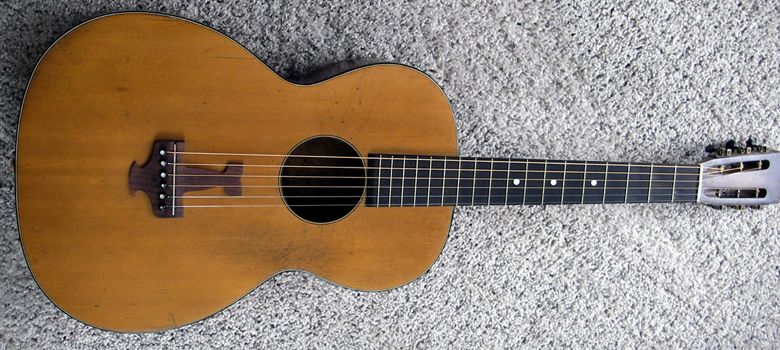
This Windsor Whirle was made in Birmingham, UK, according to the eBay seller in the 1920s. Myself, I'm not so sure about that, and would widen the timeframe to anytime in the 20th Century up until the 1940s. But perhaps the seller knows something that I do not.
The guitar (or whatever it is) is not in the best of condition having developed a split in the back right down the centre. However, I feel it is worth showing here because it's such an unusual-looking instrument.
Although the seller refers to it as a "tenor guitar", I wonder if it was actually intended as a baritone ukulele. Note the gut or nylon strings rather than a tenor's usual steel strings (you can see also that the bridge was never intended for steel strings) plus the relative compactness of the whole design. The scale length is said to be 52cm - that's nearly 20 1/2" - which is nearer to baritone ukulele scale than tenor guitar (usually about 23").
A Google search for "Windsor Whirle" will tell you that they produced a range of banjos in that name. Note also the banjo-like headstock on the instrument pictured here.
(For some reason I get a sense of deja vu about this whole blog post. I could swear I've posted something similar before but cannot find it in the archives).
G L Wilson
© 2011, Guitarz - The Original Guitar Blog - now in its 10th year!
This Windsor Whirle was made in Birmingham, UK, according to the eBay seller in the 1920s. Myself, I'm not so sure about that, and would widen the timeframe to anytime in the 20th Century up until the 1940s. But perhaps the seller knows something that I do not.
The guitar (or whatever it is) is not in the best of condition having developed a split in the back right down the centre. However, I feel it is worth showing here because it's such an unusual-looking instrument.
Although the seller refers to it as a "tenor guitar", I wonder if it was actually intended as a baritone ukulele. Note the gut or nylon strings rather than a tenor's usual steel strings (you can see also that the bridge was never intended for steel strings) plus the relative compactness of the whole design. The scale length is said to be 52cm - that's nearly 20 1/2" - which is nearer to baritone ukulele scale than tenor guitar (usually about 23").
A Google search for "Windsor Whirle" will tell you that they produced a range of banjos in that name. Note also the banjo-like headstock on the instrument pictured here.
(For some reason I get a sense of deja vu about this whole blog post. I could swear I've posted something similar before but cannot find it in the archives).
G L Wilson
© 2011, Guitarz - The Original Guitar Blog - now in its 10th year!
Friday, September 16, 2011
Highly customized Airline electric (formerly acoustic) guitar
guitarz.blogspot.com:
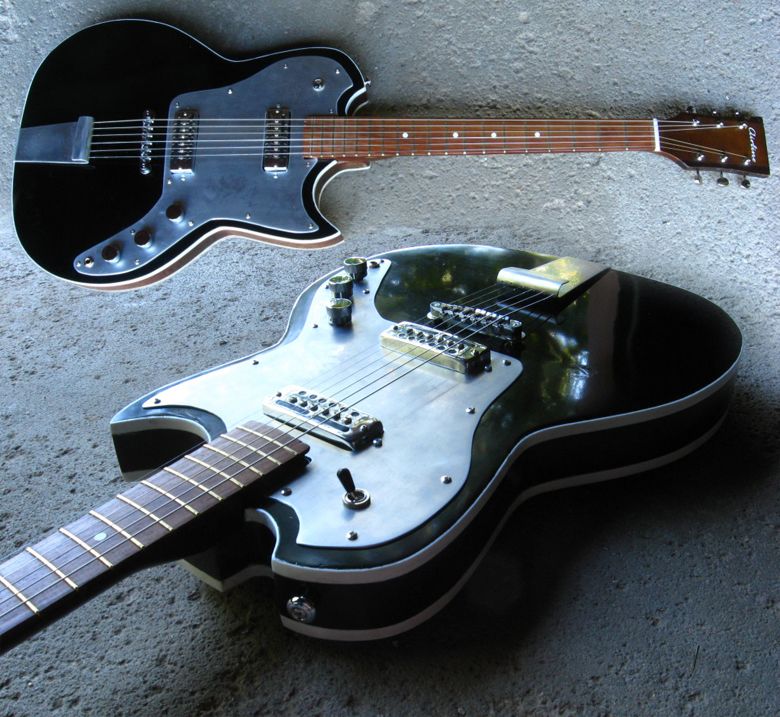
Here's an email I received this morning about the above-pictured guitar:
I'm intrigued as to what the acoustic guitar was like at the start of the project. (Any pics?) I'm hoping that it was an instrument that had seen far better days, and that with your electric conversion project that you have actually enhanced the instrument. I mean, the Airline collectors might argue that it should have been kept as a museum piece, but what's better: a guitar hanging on a wall or in a display cabinet, untouched and unplayed, or a guitar customized and brought back to life which is ready to see years and years more playing action?
G L Wilson
© 2011, Guitarz - The Original Guitar Blog - now in its 10th year!
Here's an email I received this morning about the above-pictured guitar:
I've been a reader of your blog for a little over two years, and I assured myself that if I finished a significant project- I'd send it in to Guitarz. That being said, writing this email is proving to be a rather frightening experience. I'm well aware that the mutilation of vintage musical instruments is a practice that's frowned upon by you and the vast majority of your readers. (A Peavey Predator that someone went after with a jigsaw a few weeks back comes to mind.)Could this conversion of an old Airline acoustic into an electric guitar be considered sacrilege? Well, I think we'll leave that question for the devoted Airline fans to decide on. For myself, I think it looks fantastic. There's a major difference between your customized Airline and the crudely chopped-up Peavey that you mentioned. The Peavey was a completely inexpert bodge-job that just ended up looking like an abomination. As a contrast, your customization of the Airline guitar seems to have been carried out with some reverence to the brand; it's sympathetic to the style and vintage nature of Airline Guitars and the era from which they come from.
Your write up of this project may very well read like a scathing greatest hits of your favorite amateurish DIY criticisms, with the situation worsened by the fact that I'm attempting to sell it. I'm not saying this in the hope that you'll pull punches- I'm just acknowledging that I understand what I'm getting myself into.
Johnny
I'm intrigued as to what the acoustic guitar was like at the start of the project. (Any pics?) I'm hoping that it was an instrument that had seen far better days, and that with your electric conversion project that you have actually enhanced the instrument. I mean, the Airline collectors might argue that it should have been kept as a museum piece, but what's better: a guitar hanging on a wall or in a display cabinet, untouched and unplayed, or a guitar customized and brought back to life which is ready to see years and years more playing action?
G L Wilson
© 2011, Guitarz - The Original Guitar Blog - now in its 10th year!
Friday, August 19, 2011
Celtic Moon - giant balalaika-like triangular acoustic guitar
guitarz.blogspot.com:
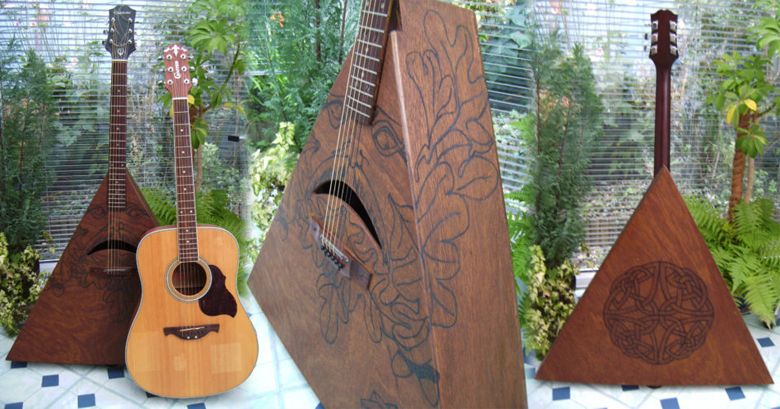
Someone has rather inexpertly attached an Epiphone neck to a large triangular wooden box - using screws straight through the fingerboard into, I guess, a block inside the corner of the box - to produce this so-called Celtic Moon guitar. The resultant guitar is enormous, as can be seen when pictured next to a Crafter D6 dreadnaught-sized acoustic. The guitar is decorated with a Celtic knot on the reverse and a Green Man on the front with the mouth forming the soundhole. (Incidentally, the Green Man is not a Celtic image, as such, it's more a part of European folklore; however some draw parallels between the Green Man and the Celtic deity Lud a.k.a. Nodens).
Looking for all the world like a giant Russian balalaika (although not as large as the contrabass balalaika), the seller says that this guitar "... has a comfortable low action with no 'buzzing' and has a full and mellow tone, holding its state of tune over an extended period."
Perhaps it might appeal to some folkie types, but I feel that its size may be a bit restrictive, and maybe the seller is being optimistic asking £299 as a Buy It Now price.
G L Wilson
© 2011, Guitarz - The Original Guitar Blog - now in its 10th year!
Someone has rather inexpertly attached an Epiphone neck to a large triangular wooden box - using screws straight through the fingerboard into, I guess, a block inside the corner of the box - to produce this so-called Celtic Moon guitar. The resultant guitar is enormous, as can be seen when pictured next to a Crafter D6 dreadnaught-sized acoustic. The guitar is decorated with a Celtic knot on the reverse and a Green Man on the front with the mouth forming the soundhole. (Incidentally, the Green Man is not a Celtic image, as such, it's more a part of European folklore; however some draw parallels between the Green Man and the Celtic deity Lud a.k.a. Nodens).
Looking for all the world like a giant Russian balalaika (although not as large as the contrabass balalaika), the seller says that this guitar "... has a comfortable low action with no 'buzzing' and has a full and mellow tone, holding its state of tune over an extended period."
Perhaps it might appeal to some folkie types, but I feel that its size may be a bit restrictive, and maybe the seller is being optimistic asking £299 as a Buy It Now price.
G L Wilson
© 2011, Guitarz - The Original Guitar Blog - now in its 10th year!
Monday, August 15, 2011
1982 Hopf 06325 HW8 acoustic steel strings guitar
Have you ever seen such a guitar? This Hopf acoustic guitar's sound-holes are pretty unique and fit well its modernist Dreadnought design (did you know that this body shape was created by Martin in 1916 to increase the volume and hence the loudness of acoustic guitars, and named after an armored battleship?)
Again, I cannot tell enough how much in our time of vintage cult, this kind of innovation became alas too rare (the guitar is from 1982), and that guitar's culture would quickly die if some people would not keep the spirit up and keep trying and improving while most companies issue the same 3 models again and again!
Bertram
© 2011, Guitarz - The Original Guitar Blog - now in its 10th year!
Wednesday, August 10, 2011
Burns/Baldwin Virginian from the late 1960s
guitarz.blogspot.com:
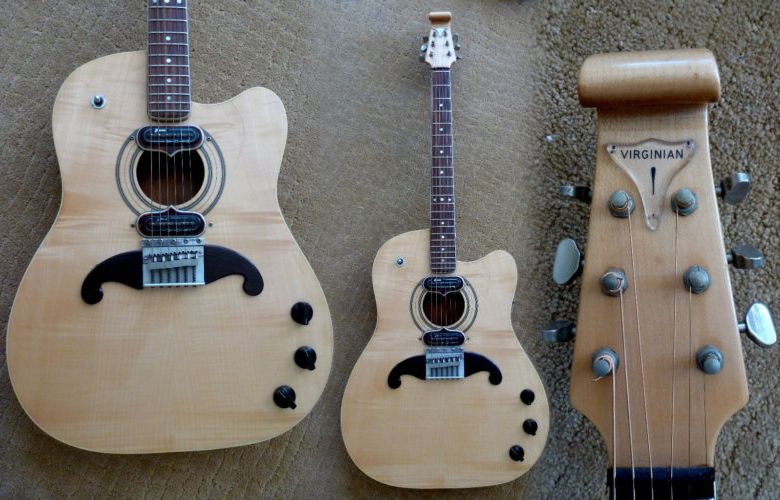
We previously looked at a prototype Virginian from Jim Burns' involvement with Hayman guitars at the beginning of the 1970s, but the design predates that era and was previously issued in the late 1960s when Burns London Ltd had been bought out by Baldwin. This 1960s Burns/Baldwin Virginian is currently being auctioned on eBay, and is another Burns guitar I would dearly like to bid on if I had the available money. Design-wise it's a cross between an acoutic and an electric, and whilst for me such hybrid designs often just do not work, there is something about the Virginian that silently screams its coolness factor at me, in much the same way that Kurt Cobain's Martin D-18E seemed so cool during Nirvana's MTV Unplugged sessions.
I can't help thinking also that this guitar must have been the inspiration behind the later Burns Steer.
G L Wilson
© 2011, Guitarz - The Original Guitar Blog - now in its 10th year!
We previously looked at a prototype Virginian from Jim Burns' involvement with Hayman guitars at the beginning of the 1970s, but the design predates that era and was previously issued in the late 1960s when Burns London Ltd had been bought out by Baldwin. This 1960s Burns/Baldwin Virginian is currently being auctioned on eBay, and is another Burns guitar I would dearly like to bid on if I had the available money. Design-wise it's a cross between an acoutic and an electric, and whilst for me such hybrid designs often just do not work, there is something about the Virginian that silently screams its coolness factor at me, in much the same way that Kurt Cobain's Martin D-18E seemed so cool during Nirvana's MTV Unplugged sessions.
I can't help thinking also that this guitar must have been the inspiration behind the later Burns Steer.
G L Wilson
© 2011, Guitarz - The Original Guitar Blog - now in its 10th year!
Thursday, August 4, 2011
Coulter tenor guitar from Portland, OR, possibly 1930s, with weird shaped soundholes
guitarz.blogspot.com:
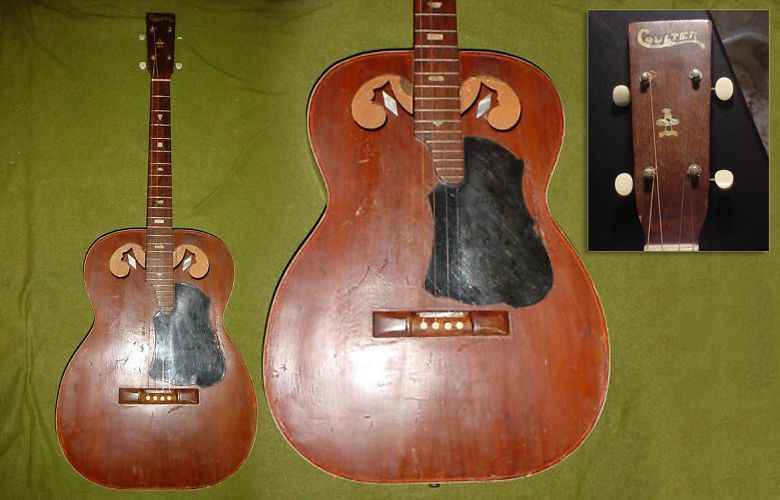
This Coulter tenor guitar, which the ebay seller tells us is from the 1930s and "plays great", is currently being auctioned with a starting bid of $699.99. Coulter is a name I haven't previously been aware of. The name on the headstock does look as if it has been painted on freehand; maybe it's been "re-touched" by someone at some stage in the guitar's life. The seller tells us that:
G L Wilson
© 2011, Guitarz - The Original Guitar Blog - now in its 10th year!
This Coulter tenor guitar, which the ebay seller tells us is from the 1930s and "plays great", is currently being auctioned with a starting bid of $699.99. Coulter is a name I haven't previously been aware of. The name on the headstock does look as if it has been painted on freehand; maybe it's been "re-touched" by someone at some stage in the guitar's life. The seller tells us that:
This guitar was built in Portland, OR, in the early part of the 1900s. F.E. Coulter was active from 1910 into the 1930s. Coulter built guitars, banjos, violins and mandolins, all of which featured his unique design sense.There are mother of pearl inlays on the neck, body and heel of the neck as as seen in the pictures. This guitar is very lightweight and loud. Not sure what woods were used, but I believe the top is redwood. There have been extensive repairs done by a local (Portland) luthier. All cracks and gaps have been sealed and braced and all the interior bracing has been repaired. The neck shows a bit of bowing, as should be expected, but is well attached to the body and not pulled in. More cosmetic restoration could be done, but I leave that up to the digression of the buyer. For more on F. E. Coulter check this link for a WPA Writers Project interview with the builder: http://freepages.genealogy.rootsweb.ancestry.com/~janeha/fcoulter-folklore.htmlI have to say that those weird kidney-shaped soundholes are about the ugliest I have ever seen.
G L Wilson
© 2011, Guitarz - The Original Guitar Blog - now in its 10th year!
Tuesday, August 2, 2011
Vintage Kay Waldorf archtop acoustic guitar
guitarz.blogspot.com:
Thanks to Fawlty Towers I know what a Waldorf Salad is, but I'd never previously been aware of a Waldorf guitar. There is little information about these guitars on the internet, but from what little I am able to piece together it would seem that this guitar bearing the brandname Waldorf is actually a Kamico, a sub-brand of Kay Guitars made in Chicago. Whereas other brandnames were sold through certain retailers, such as Old Kraftsman for Spiegel, Sherwood and Airline for Montgomery Wards, Penncrest for JC Penney, and Silvertone for Sears, the Waldorf brand - from what I can gather - was created at the behest of the Waldorf Astoria Hotel in New York at around the time of the Big Band era of the 1940s.
G L Wilson
© 2011, Guitarz - The Original Guitar Blog - now in its 10th year!
Thanks to Fawlty Towers I know what a Waldorf Salad is, but I'd never previously been aware of a Waldorf guitar. There is little information about these guitars on the internet, but from what little I am able to piece together it would seem that this guitar bearing the brandname Waldorf is actually a Kamico, a sub-brand of Kay Guitars made in Chicago. Whereas other brandnames were sold through certain retailers, such as Old Kraftsman for Spiegel, Sherwood and Airline for Montgomery Wards, Penncrest for JC Penney, and Silvertone for Sears, the Waldorf brand - from what I can gather - was created at the behest of the Waldorf Astoria Hotel in New York at around the time of the Big Band era of the 1940s.
G L Wilson
© 2011, Guitarz - The Original Guitar Blog - now in its 10th year!
Sunday, July 31, 2011
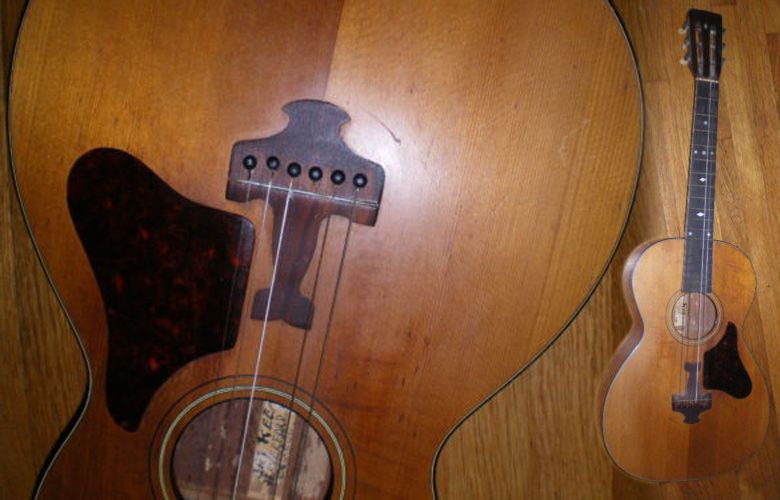
Harmony Parlour guitar, circa 1927-34, with airplane bridge in honour of Charles Lindbergh
guitarz.blogspot.com:
Today I want to show you something that represents a minor footnote in the history of the guitar, but nonetheless is one of those little factoids that I find fascinating.
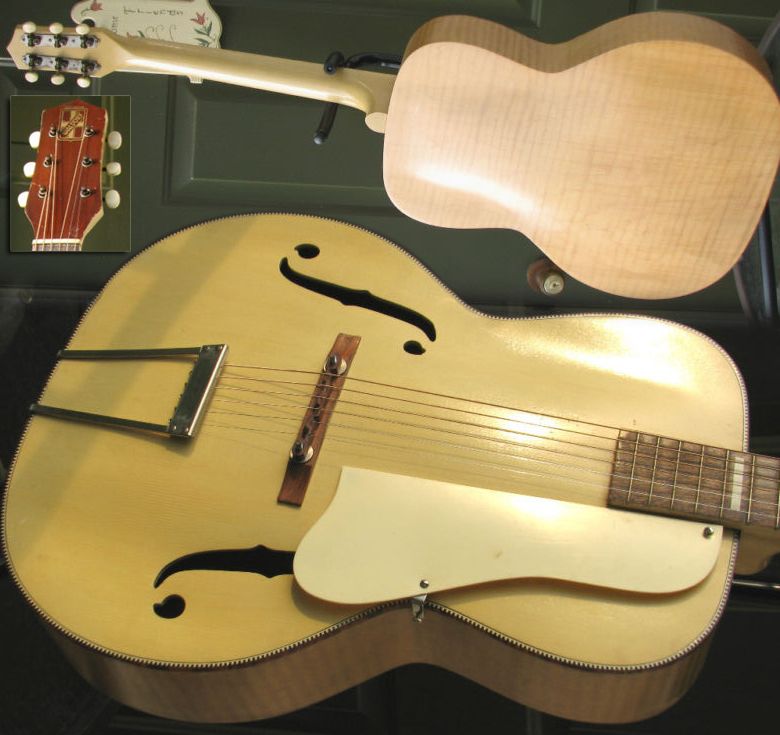
The above pictured "Mystery guitar" was recently being offered for sale on eBay. The seller was commenting that they had never seen a bridge quite like this on any guitar.
It is actually a Harmony parlour guitar featuring an airplane bridge, which Harmony began putting on their guitars in honour of Charles Lindbergh's Orteig Prize-winning solo non-stop flight in his aircraft Spirit of St. Louis on May 20–21, 1927, from Roosevelt Field located in Garden City on New York's Long Island to Le Bourget Field in Paris, France. At the time this was major news, spawning all kinds of merchandise and references in popular culture; Harmony were merely jumping on the bandwaggon and such was the sensation surrounding Lindbergh's achievement that Harmony went on producing guitars with these bridges until 1934.
Here is another example of a Harmony with airplane bridge currently being auctioned on eBay.
Quite how the bridge affects the sound of the guitar, I couldn't say. On the one hand the increased footprint should transmit more of the strings vibration to the guitar's top, but on the other hand it could also have a dampening effect on the top. Nevertheless the eBay sellers have been claiming that these are incredible sounding blues machines. Take that as you will; it could be true or there may be a touch of eBay seller "spin" going on there.
G L Wilson
© 2011, Guitarz - The Original Guitar Blog - now in its 10th year!
Today I want to show you something that represents a minor footnote in the history of the guitar, but nonetheless is one of those little factoids that I find fascinating.
The above pictured "Mystery guitar" was recently being offered for sale on eBay. The seller was commenting that they had never seen a bridge quite like this on any guitar.
It is actually a Harmony parlour guitar featuring an airplane bridge, which Harmony began putting on their guitars in honour of Charles Lindbergh's Orteig Prize-winning solo non-stop flight in his aircraft Spirit of St. Louis on May 20–21, 1927, from Roosevelt Field located in Garden City on New York's Long Island to Le Bourget Field in Paris, France. At the time this was major news, spawning all kinds of merchandise and references in popular culture; Harmony were merely jumping on the bandwaggon and such was the sensation surrounding Lindbergh's achievement that Harmony went on producing guitars with these bridges until 1934.
Here is another example of a Harmony with airplane bridge currently being auctioned on eBay.
Quite how the bridge affects the sound of the guitar, I couldn't say. On the one hand the increased footprint should transmit more of the strings vibration to the guitar's top, but on the other hand it could also have a dampening effect on the top. Nevertheless the eBay sellers have been claiming that these are incredible sounding blues machines. Take that as you will; it could be true or there may be a touch of eBay seller "spin" going on there.
G L Wilson
© 2011, Guitarz - The Original Guitar Blog - now in its 10th year!
Subscribe to:
Posts (Atom)

