Sunday, November 27, 2011


Saturday, November 26, 2011
Custom 77 Roxy - a new classic?

I know that I probably spend much too much time ranting here about how unimaginative guitar making became in the last decades, so let's cut the crap and rejoice over creative luthiers and small companies that can still produce guitars such as the Custom 77 Roxy, an original yet sober, timeless and classy semi-hollow wonder that has everything it takes to become a new classic.
I love this guitar, firstly for its beautiful bevelled outline, both sensual and dynamic, and the fact that it's a semi-hollow that doesn't have to be a copy of an ES-335 to have credibility. I also appreciate the Duesenberg-style bridge humbucker + neck P90 combination, the simple pickguard, the wraparound bridge, the old-school F-hole on this radical body, and the controls positions seem to be well thought - not just placed where tradition tells... I just wish it was bigger but it's just because I'm big and I'm still looking for my dream semi-hollow guitar!
Custom 77 is an interesting French guitar company that released nice original models, on top of producing the inevitable Fender/Gibson copies (it's probably necessary to generate basic income, but that's the buyers's fault, isn't it?) - all with Iggy/Ramones/Clash inspired names - plus basses and acoustic guitars, also drums and cymbals and they just started an effects boutique line. I will keep an eye on this company because I'm sure that they will keep releasing new cool stuff and one day I will want some of it...
Bertram
© 2011, Guitarz - The Original Guitar Blog - now in its 10th year!
1968 Fender Coronado II semi-hollowbody in southpaw edition and Antigua finish
guitarz.blogspot.com:
 Here's another left-handed Fender in Antigua finish, this one being their almost forgotten first attempt at a semi-hollowbody guitar, the Fender Coronado II. The Coronado series was designed by Roger Rossmeisl, who had previously designed guitars for Rickenbacker, and were produced between 1966 and 1972. The Coronado models I and II differed in number of pickups (which, incidentally, were made by DeArmond), the Coronado I having a single neck pickup and the Coronado II having an additional pickup in the bridge position. There was also a 12-string model, the Coronado XII, plus a bass model. Antigua was not the only rare finish, as a number of Coronado II and XIIs were made in Wildwood editions with bodies constructed of highly grained beech wood from trees which had been injected with colourful chemical dyes before being harvested.
But back to the Antigua finish. Note how the 1960s Antigua differs from that produced in the late 1970s. The 60s version is almost a cream to black burst, whereas in the 1970s the whole burst effect is more "mushroom"-like. A few years ago I had one of the Crafted In Japan Fender Strat reissues in Antigua, and the colour was different yet again having more of a green tinge to it.
What's more, the eBay listing tells us that the above-pictured Fender Coronado II originally had a cherry finish before being refinished in the factory in Antigua. I had heard the the Antigua finish was originally developed to hide a mistake and wonder if this might be the reason for this guitar being refinished. (Anyone know the full story?)
Anyway, this guitar is currently being offered for sale on eBay with a Buy It Now price of $2,590.
G L Wilson
Additional: Via the comments Sam writes:
© 2011, Guitarz - The Original Guitar Blog - now in its 10th year!
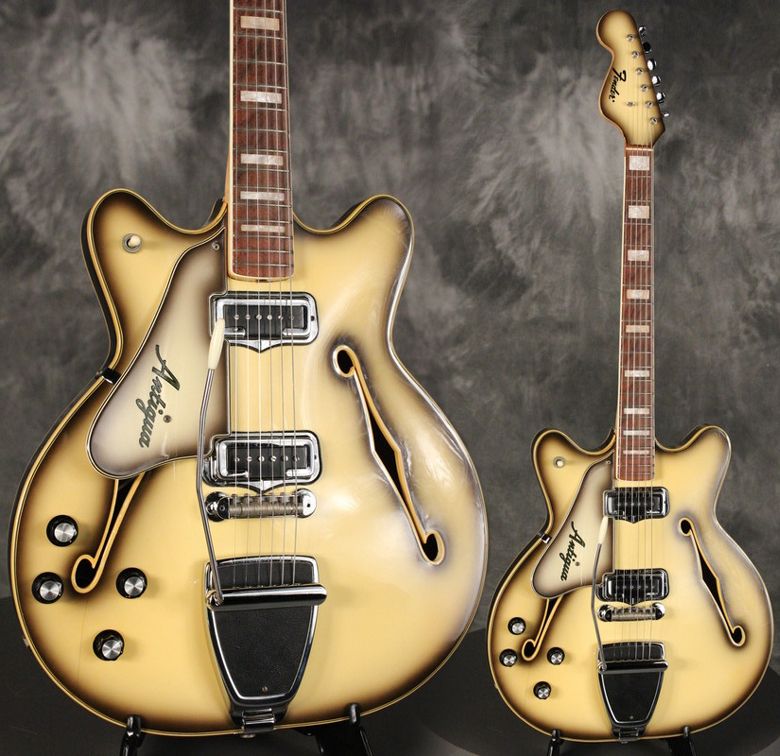
But back to the Antigua finish. Note how the 1960s Antigua differs from that produced in the late 1970s. The 60s version is almost a cream to black burst, whereas in the 1970s the whole burst effect is more "mushroom"-like. A few years ago I had one of the Crafted In Japan Fender Strat reissues in Antigua, and the colour was different yet again having more of a green tinge to it.
What's more, the eBay listing tells us that the above-pictured Fender Coronado II originally had a cherry finish before being refinished in the factory in Antigua. I had heard the the Antigua finish was originally developed to hide a mistake and wonder if this might be the reason for this guitar being refinished. (Anyone know the full story?)
Anyway, this guitar is currently being offered for sale on eBay with a Buy It Now price of $2,590.
G L Wilson
Additional: Via the comments Sam writes:
I have a book on Fender called The Fender Electric Guitar Book: A Complete History Of Fender Instruments.So yeah, perfectly conceivable - and very likely - that this was one such Coronado originally finished in cherry and then refinshed in Antigua by Fender after the binding failure damaged the previous finish. - GLW
Here's what it says: "Virgilio 'Babe' Simoni remembered a particular problem with the Coronados... 'We couldn't get the binding material to stick to the Coronados,' he said later. 'We'd bind them at night and come back in the morning and the thing would be popped loose. [So we had to] re-bind them several times, and the veneer is very thin on them.' In order to cover up the burn marks caused by this re-binding, the team had no choice but to devise a special white-to-brown shaded finish, which they called Antigua, to salvage the scorched Coronados."
© 2011, Guitarz - The Original Guitar Blog - now in its 10th year!
"Leningrad Hodad" by North of Malibu featuring three Waterstone custom light show guitars
guitarz.blogspot.com:
Thanks to Greg Cadman who posted this video clip on the Guitarz Facebook page.
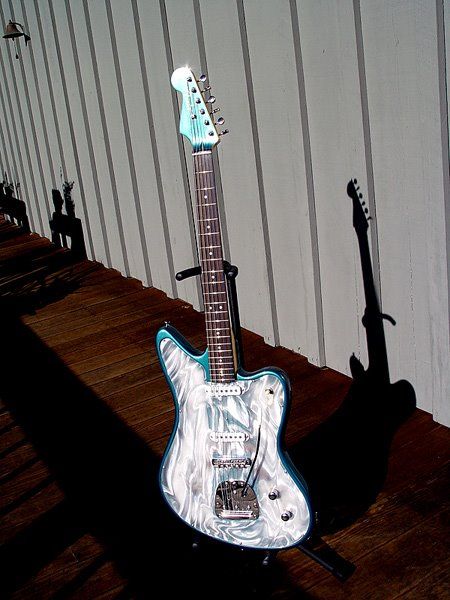
Interesting guitars, custom-made by Waterstone Guitars they are styled after a Fender Jazzmaster/Jaguar design with reverse headstocks and with a Rickenbacker-style lightshow.

G L Wilson
© 2011, Guitarz - The Original Guitar Blog - now in its 10th year!
Thanks to Greg Cadman who posted this video clip on the Guitarz Facebook page.
Interesting guitars, custom-made by Waterstone Guitars they are styled after a Fender Jazzmaster/Jaguar design with reverse headstocks and with a Rickenbacker-style lightshow.
G L Wilson
© 2011, Guitarz - The Original Guitar Blog - now in its 10th year!
Friday, November 25, 2011
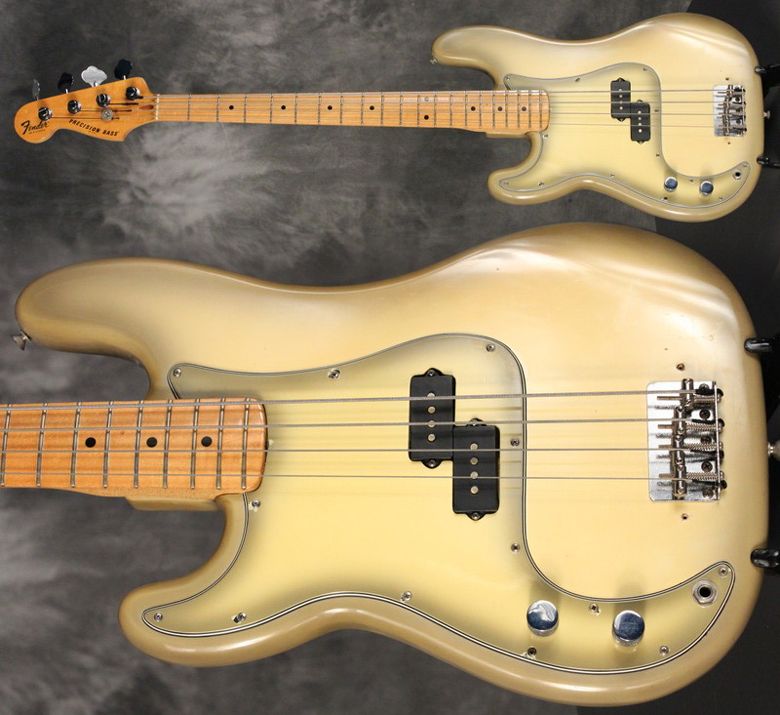
Southpaw Fender Precision Bass in Antigua finish
guitarz.blogspot.com:
 What's rarer than a late 1970s Fender Precision Bass in Antigua finish? Well, how about a left-handed late 1970s Fender Precision Bass in Antigua finish? The seller actually claims that this example is from 1980 despite the headstock displaying a 1970s serial number (S followed by 6 digits), but it is perfectly possible that this was assembled in 1980 by Fender from parts already in stock from a year or two previously.
This bass is currently listed on eBay with a Buy It Now price of $2,790.
If any of our regular readers are indeed southpaws and would like to join the Guitarz team with a view to writing pieces on the most interesting lefty guitars and basses on eBay and elsewhere, then please do get in touch!
G L Wilson
© 2011, Guitarz - The Original Guitar Blog - now in its 10th year!
This bass is currently listed on eBay with a Buy It Now price of $2,790.
If any of our regular readers are indeed southpaws and would like to join the Guitarz team with a view to writing pieces on the most interesting lefty guitars and basses on eBay and elsewhere, then please do get in touch!
G L Wilson
© 2011, Guitarz - The Original Guitar Blog - now in its 10th year!
Thursday, November 24, 2011
Leroy "Sugarfoot" Bonner plays his trademark Mosrite doubleneck (with the Ohio Players)
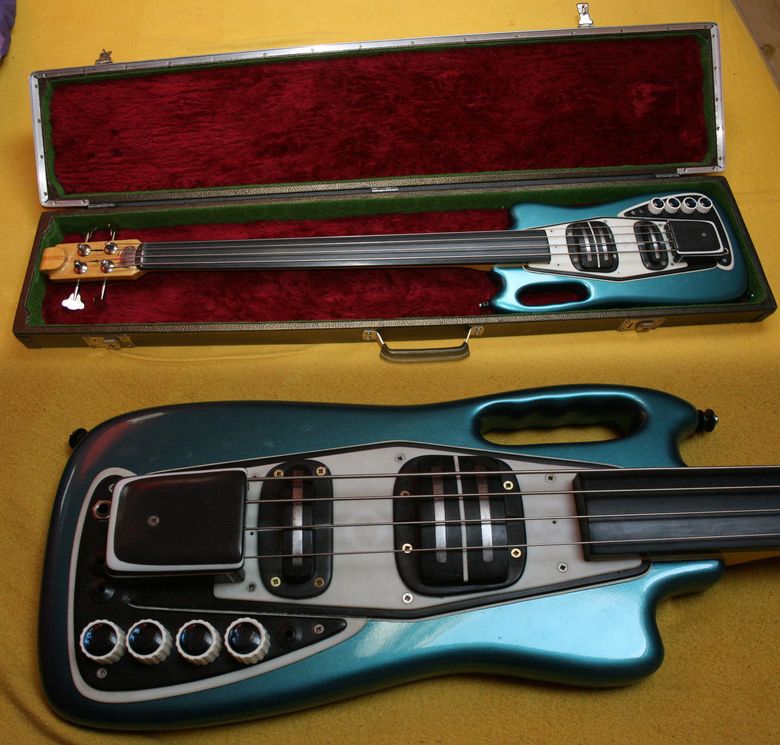
Can you identify this fretless bass guitar?
guitarz.blogspot.com:
 I have absolutely no idea as to the identity of this small-bodied fretless bass guitar currently listed on eBay UK. It's a weird one for sure with quite a space-age design incorporating a monkey grip in the body, three pickups, and unusual looking hardware. I'd guess that it might be Eastern European, but that really is a shot in the dark. If anyone can give us a more definite idenification, then please let us know via the comments!
Thanks to Alex for bringing this oddity of a bass to my attention.
G L Wilson
© 2011, Guitarz - The Original Guitar Blog - now in its 10th year!
Thanks to Alex for bringing this oddity of a bass to my attention.
G L Wilson
© 2011, Guitarz - The Original Guitar Blog - now in its 10th year!
Washburn MR-400 Custom

Usually I loathe this kind of paint jobs, the easy and intruding horror comics/graffiti style that reduces everything it touches into pathetic boyish machismo. But I must say that in the case of this Washburn MR-400 it's surprisingly good, with this close-up framing that turns the image into a quasi -abstract pattern - it's unusually intelligent for this kind of things, and gives it an enjoyable second degree.
On top of this, the guitar is quite cool I must say. As far as I understood, the Washburn MR series models are Sammy Hagar signatures - the 400 being the P90s version - and look like thinline wider LPs with strangely shaped and placed soundholes - a very nice touch, mostly combined with the florentine cutaway. The paint job comes from Washburn's custom shop.
I have problems understanding Washburn's policy: it's an old company that has been there for ever and that could claim to belong to the holy ancients, but they seem to keep low profile, for example they don't keep archives of their discontinued models - and they've had prestigious users like Brian May or Roger Waters who even had a signature model (not to mention Paul Stanley, but who can still think that KISS is attractive?) - and don't try to claim a 'cult' status like many of their competitors on the guitar market... They have original though classic designs, also innovative technology, but their catalogue is full of LPs clones and superstrats... I have a good feeling though about their products, but it's a blur impression really not based on how they communicate about themselves!
Bertram
© 2011, Guitarz - The Original Guitar Blog - now in its 10th year!
Wednesday, November 23, 2011
Vintage & Rare guitar of the week: Liquid Metal Guitars LMG T WS engraved aluminium Tele
guitarz.blogspot.com:
 Here's another highly decorated Telecaster-type guitar, the Liquid Metal Guitars LMG T WS. The W and S in the guitar's name are the initials of Warren Smith, an engraver and master craftsman in metals, based in Armstrong, B.C., who has been working on jewellery pieces for over 20 years and has recently relished the opporunity of working on the larger canvasses offered by LMG's guitar bodies.
This guitar is being sold via Vintage & Rare priced at €2,999. See Vintage & Rare for more details.
G L Wilson
© 2011, Guitarz - The Original Guitar Blog - now in its 10th year!
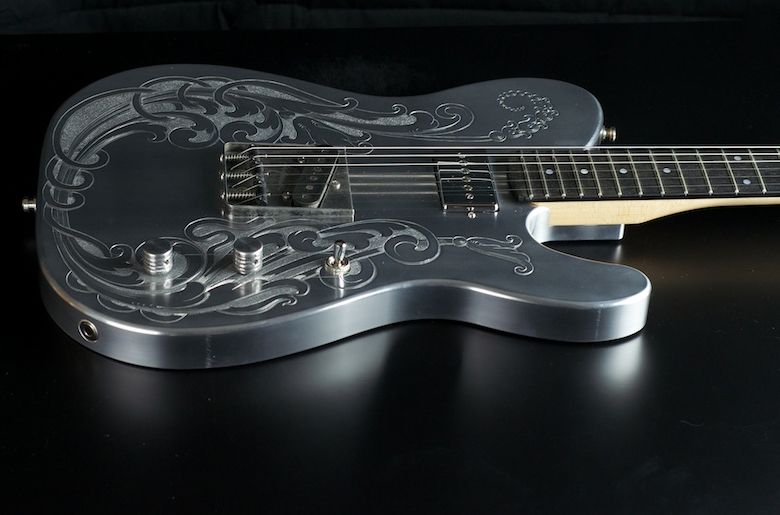
This guitar is being sold via Vintage & Rare priced at €2,999. See Vintage & Rare for more details.
G L Wilson
© 2011, Guitarz - The Original Guitar Blog - now in its 10th year!
Tuesday, November 22, 2011
Fender Japan Floral Print Telecasters - a modern take on the Paisley and Blue Flower designs
guitarz.blogspot.com:
 They are probably too flowery for many guitarists' tastes, but I think these new floral print Telecasters from Fender Japan (official designation TL69-SPL) are quite stunning. Perhaps you'd need to wear a Hawaiian shirt (or more appropriately a silk kimono) whilst playing one, or maybe that would be overkill.
Other than the particularly loud finish on, each of the three designs available are based on a pretty standard Tele with basswood body, one-piece maple neck, the usual two Tele pickups, and 3-saddle Telecaster ashtray-style bridge.
Thanks again to Keith McCreary who has obviously been closely scrutinizing the Fender Japan website.
G L Wilson
© 2011, Guitarz - The Original Guitar Blog - now in its 10th year!
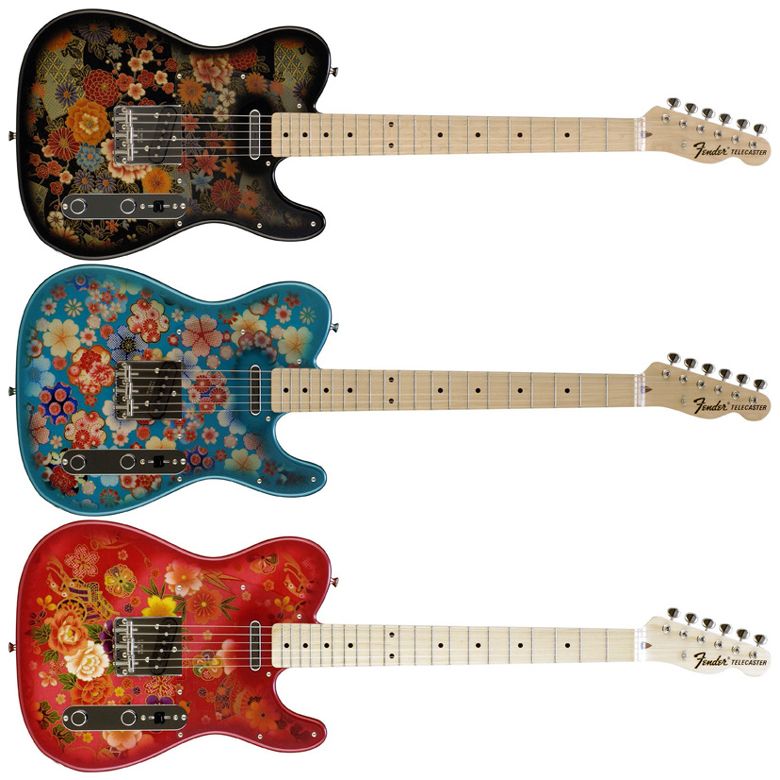
Other than the particularly loud finish on, each of the three designs available are based on a pretty standard Tele with basswood body, one-piece maple neck, the usual two Tele pickups, and 3-saddle Telecaster ashtray-style bridge.
Thanks again to Keith McCreary who has obviously been closely scrutinizing the Fender Japan website.
G L Wilson
© 2011, Guitarz - The Original Guitar Blog - now in its 10th year!
Official Fender Japan limited edition Spider Man Mustang guitar
guitarz.blogspot.com:
 We've looked at guitars based on comic book superheroes before (e.g. Superman and Batman) but this Spider Man guitar is official Fender product. Issued by Fender Japan, the Fender MG Spider-Man is a Mustang with basswood body, 2 singlecoil pickups with on/off/phase switch settings for each and the now legendary Dynamic Vibrato for which the Mustang is famous. But most obviously it has an in-your-face Spider Man finish which may be a little too pink for the tastes of some sensitive souls. It even has a competition stripe of sorts, a "Spidey" competition stripe, I guess.
If you want one, you'll have to be quick because this is a limited edition of only 50 examples; also it's my understanding that these are being produced for the Japanese market only, so good luck in trying to track one down. (Why is it that Fender Japan always seems to have the most exciting range of Fender guitars?)
Thanks to Keith McCreary for bringing this guitar to our attention.
G L Wilson
© 2011, Guitarz - The Original Guitar Blog - now in its 10th year!
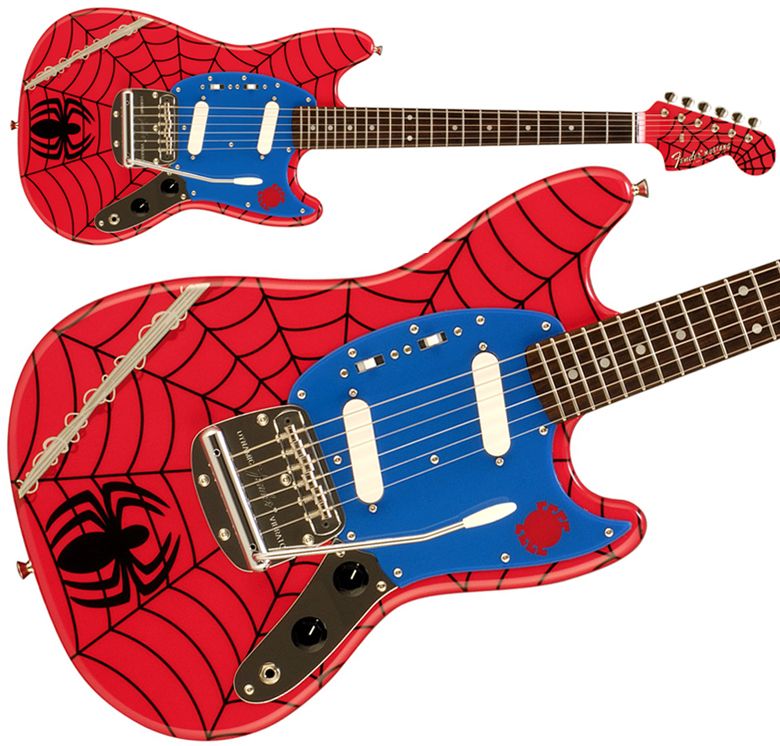
If you want one, you'll have to be quick because this is a limited edition of only 50 examples; also it's my understanding that these are being produced for the Japanese market only, so good luck in trying to track one down. (Why is it that Fender Japan always seems to have the most exciting range of Fender guitars?)
Thanks to Keith McCreary for bringing this guitar to our attention.
G L Wilson
© 2011, Guitarz - The Original Guitar Blog - now in its 10th year!
STIRRED is now available
If you read this blog, please show your support by buying STIRRED, the final Jack Daniels novel, currently $2.99 on Amazon.com.
http://www.amazon.com/Stirred-Jacqueline-Daniels-Mysteries-ebook/dp/B0050KIRDC
Happy Turkey Day to all!
Never mind the CBGs here a Marks and Spencers biscuit tin guitar!
guitarz.blogspot.com:
 Very much in the style of a cigar box guitar, this three-stringer is a Marks & Spencers Biscuit Tin guitar based on a novelty biscuit tin shaped like a Marks & Spencers delivery van.
This guitar is currently listed on eBay UK with a starting price of £0.99. The seller very honestly comments that: "As you would expect, it ain't a great sound, but it is great fun!"
G L Wilson
© 2011, Guitarz - The Original Guitar Blog - now in its 10th year!
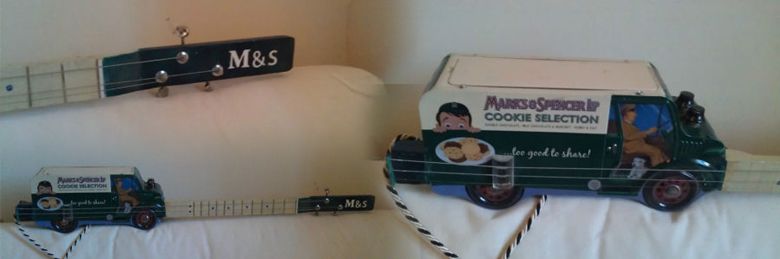
This guitar is currently listed on eBay UK with a starting price of £0.99. The seller very honestly comments that: "As you would expect, it ain't a great sound, but it is great fun!"
G L Wilson
© 2011, Guitarz - The Original Guitar Blog - now in its 10th year!
Monday, November 21, 2011
Guest Post by Stephen Leather

Stephen sez: Tomorrow (November 22) is a big day for me. After selling close to half a million eBooks over the past twelve months I’m now taking a step back from self-publishing. I’ve spent twelve months promoting, marketing, plugging, Facebooking and tweeting and I’m exhausted. It’s time for someone else to do the hard work so that I can do what I do best – write.
So as of tomorrow Amazon Encore takes over the publishing of Once Bitten, one of my bestselling self-published eBooks. Next week they take over The Basement, which topped the UK Kindle charts for several months and sold more than 150,000 copies.
Then early next year Amazon’s new imprint 47North is publishing my three Jack Nightingale supernatural detective series – Nightfall, Midnight and Nightmare.
Self-publishing was always an experiment for me. In fact I was one of the first authors to self-publish on the Kindle, in the days before KDP when authors had to go via a company called Mobipocket. I hardly sold any and months would go by without a single sale.
But everything changed for me in the summer of 2010 when Amazon opened its first Kindle store outside of the US and allowed us Brits to buy from Amazon.co.uk. The new store, plus the fact that the Kindle was about to become the most Christmas-gifted item of all time, gave me the impetus to start self-publishing.
Exactly twelve months ago I put up three more eBooks on the Kindle through Amazon’s KDP platform, books that my UK publisher Hodder and Stoughton had turned down. There was a vampire story (Once Bitten), a serial killer novella (The Basement) and a science fiction murder mystery (Dreamer’s Cat).
It’s been a resounding success. I don’t know of any UK-based author who has sold more self-published books. (Though fellow Brit Lee Child of course was one of the first to hit the one millions Kindle sales mark).
Over the last twelve months I sold 155,662 copies of The Basement through the UK Kindle store. Mainly at the Amazon minimum (75p plus 11p tax in the UK) but over the last couple of months the price has gone up to £1.49 (about $2).
Over the same period I sold 82,583 copies of Once Bitten and 19,810 copies of Dreamer’s Cat. The Kindle success spilled over onto the other eReaders and by the summer I was selling tens of thousands of copies a month on iBooks.
My sales in the US were much lower – just 5,197 copies of The Basement and 2,397 copies of Once Bitten over the year. I pretty much tried everything to boost my US sales. I blogged, I tweeted, I gave away free copies, I posted on the Kindle US forum (not a pleasant experience, it has to be said). Nothing worked. Even a guest blog on Joe’s site only shifted a few dozen extra copies. Eventually I gave up trying to sell cut-price books on the Kindle in the US and raised my prices to $3.99. Earnings from the US held steady throughout the year at about $1,200 a month – less than a tenth of my UK earnings.
That’s why I’m so excited about the Amazon Encore deal. Yes, I’ll get a lower royalty rate (they don’t pay the 70 per cent royalty on Amazon Encore books, no matter what the price they sell at). And yes I lose control over the marketing and pricing.
But I’m hoping that Amazon’s marketing expertise will kick in and hopefully replicate my UK success in the US. Their massive database knows which customers like vampire stories and which prefer serial killer stories. They’ll be able to offer my books to the right customers, hopefully at the right price. I’ve seen them do it several times in the UK, where the Amazon imprints have launched American writers into the UK Top 10. It’s as impressive as hell, they can do in hours what it takes me weeks to do. If they can do that for me in the US then the sky’s the limit. Say the US market for Kindle eBooks is five times that of the UK’s – if that’s the case then there’s no reason that Amazon Encore couldn’t sell a million copies of The Basement and Once Bitten. I’m keeping my fingers crossed.
But one of the fascinating things for me about my whole Kindle experiment has been the support I’ve received from my UK publisher, Hodder and Stoughton. I’ve been with them for more than twenty years, ever since they paid a six-figure sum for my books The Chinaman and The Vets. It was that advance that launched my career as a full-time writer and changed my life forever.
Not only were Hodder supportive of my eBook experiment, they also joined in and cut the price of one of my thrillers to 49p. The book, Hard Landing, is the first in my Spider Shepherd undercover cop series – and over the last 12 months Hodder have sold more than 120,000 copies. It spent weeks at the top of the Kindle UK chart and only recently dropped out of the Top 100.
And not only that, there was an immediate boost in sales of all the other books in the series – and they were selling at £4.99 each. Over the year they sold more than 35,000 Spider Shepherd eBooks at that price.
But the really big surprise for them came this summer when they released the latest book in the Spider Shepherd series – Fair Game. Sales of the paperback were twenty per cent up on the previous book at a time when the UK thriller market as a whole was well down.
It’s become clear that my success with eBooks has fed through to my legacy publishing books in a big way. But it’s also clear that my publisher is keen to help me build on that success. So this year I have signed deals to write five more books for them in return for an advance of close to US$750,000.
I know there are those who’d say that I’d make more money doing books myself. But I’m not so sure.
Publishers publish. That’s what they’re good at. They find writers, they help shape their stories, and they sell them. All that’s changing is the method of selling stories, from paperbacks to eBooks. The big publishers are like oil tankers, it takes a lot of effort to make them change their direction and speed, but once they have moved they have one hell of a lot of momentum. Yes, I can arrange the editing myself, design covers, market, promote and publicise. But that’s hard work and it’s not what I’m good at. I’m a writer. I write. And I’d rather concentrate on writing and let my publisher get on with publishing.
Yes, the industry is changing. Yes, sales of paperbacks are down and sales of eBooks are rising. Without a shadow of a doubt the eBook market will dominate in the future. But I think what we have seen over the past year has been a bubble, a bubble that is now slowly deflating. Not a bubble in sales – but a bubble in the performance of self-published eBooks. A year ago, when I started my eBook experiment, it was relatively easy to get three of my books into the Amazon Kindle UK bestseller list. And they stayed there – for months. Only last month did they leave the Top 50. But an eBook I released last month – optimistically titled The Bestseller – went into the Top 10 but didn’t stay there for long. And most of the eBooks that were doing so well earlier this year have pretty much disappeared from the bestseller lists. The self-published authors who were shouting that the traditional publishing industry was dead and that the future lay with them are now seeing their books dropping out of the Top 1000 and sales slowing to a trickle.
In their place we’re seeing the old faces starting to dominate the bestseller list – Lee Child, Stephen King, Michael Connelly, PD James. The usual suspects. And among them are the Amazon-published authors benefiting from Amazon’s marketing muscle.
Why is it happening? I don’t know. It might be that the marketplace is changing, it might be that Amazon has changed the way it compiles its bestseller lists. But the cause doesn’t matter – it’s the effect that counts. And I think that bit by bit we’ll see the legacy publishers tighten their grip on the eBook bestseller lists, and the self-published books will find it harder and harder to make any sort of impression.
Don’t get me wrong, I know that I’m far from being the typical self-publisher. And what works for me probably wouldn’t work for a writer who has never had a traditional publishing deal or who is only just getting started. But I’m happy enough now to get off the self-publishing treadmill and let someone else do the hard work. I’ve got books I want to write!
Joe sez: First off, I'm thrilled for Stephen's success. It's nice to see someone do well in the UK, because my sales there have been mediocre (I make about what Stephen makes in the US, about $1500 a month). So there IS a UK market, I just haven't been a huge success there. Yet.
Yet is the operative word, because I've learned something about ebooks that doesn't mirror paper releases--bestsellers are no longer dependent on the release date. My novel The List has been in the Top 100 on three separate occasions. Sales of the rest of my backlist have fluctuated wildly as well.
No ebook can remain in the Top 100 forever. A saturation point is eventually reached as the number of Kindle owners browsing the list buy a copy.
But the people browsing the list this month may not be the same people browsing it next year. As more Kindles are sold, more readers can discover your ebook. Legacy publishers have said for years that readership is stagnant in the paper book world. This isn't how it works in the ebook world. A new release gets some attention, and this spurs sales, but an older book can also get attention via word of mouth, a push from Amazon, or some publicity or marketing effort. That release will be new to new Kindle owners, or to Kindle owners that missed it the first time, and sales can once again spike.
While I find it interesting that Stephen's legacy publisher was willing to experiment with price, and then offer him a large contract, I don't react with optimism to this development. I've been begging my publishers for years to lower my prices, and they do whatever the hell they want. As a result, even though I have more legacy novels than self-pubbed novels, my self-pub outsell my legacy 5 to 1.
You see, legacy publishers know they're stuck. On one hand, they've seen ample evidence that low prices lead to more sales and ultimately more profit. On the other hand, they are worried that if they flood the market with low priced ebooks, each title will make less money overall, which when coupled with dwindling paper sales will put them out of business.
Tomorrow Stirred is launching. I'm pretty sure it will hit the Kindle Top 100, and I'm hoping (like Shaken) it will hit the Top 10. Combined, Blake and I have sold over 650,000 ebooks. Add Amazon's marketing muscle to our existing fanbase, and we have the potential to sell a whole bunch.
So, in the ebook world, name recognition and an existing fanbase plus a marketing push can equal sales. I've seen this happen time and again.
I've also seen that a marketing push, even without name recognition, can lead to sales. So can word of mouth coupled with a good book and a smart cover and a fair price. Amazon has made it very easy for readers to find things that interest them. If an author has several books out, that gives readers many chances to find them. The more virtual shelf space you have, the more ebooks you can sell.
A new release, or a big marketing push, can also buoy the sales of your backlist titles. A rising tide lifts all boats.
So what does all of this mean?
1. Write a good book with a good cover and a good description, and price it reasonably.
2. Do this many times to increase your sales. The more ebooks you have, the more chances you have to find readers.
3. Name recognition can come from prior legacy sales, or name recognition can be spontaneously created as multiple titles begin appearing on bestseller lists and fueling each others' sales.
4. Ebooks are forever, and shelf space is unlimited, so the sales of titles can actually improve over time as more readers buy ereading devices.
5. Marketing pushes, price drops, media attention, and author efforts can increase sales.
I have a theory that bestsellers exist in the legacy world because of distribution. James Patterson is everywhere, so he sells a lot. If you look at many bestselling authors, a lot of them are consistently disappointing fans, as evidenced by low star ratings and bad reviews. But because they are safe (as in familiar) and their brands are constantly being reinforced with new releases that get widespread distribution, they remain in the public eye and popular. Some of that popularity translates to ebook sales, even at high prices.
But bestsellers are still selling many more paper books than ebooks. There have only been a few bestsellers who have cracked the Kindle million club, even though their paper sales are in the multiple millions. Contrast this to midlist writers, whose ebook sales are equal to or surpass their print sales.
As print sales become smaller and smaller, we won't see as many of these familiar bestselling authors on the bestseller lists, especially if their prices remain high.
Unless you get big advance money, like Stephen did, I don't recommend taking a legacy deal. The drop Stephen is seeing in his self-pubbed titles isn't unusual--paper books begin to drop in sales almost immediately after a release. But paper sales drop faster, and hardly ever begin selling again, whereas ebooks do. I wouldn't call this a bubble. I'd call this an ongoing balance between those who have bought your ebooks and those who haven't. Some of those who have bought you will become fans and continue to buy your backlist and new releases. Some who haven't simply haven't discovered you yet. Others who haven't just aren't interested.
There must be an algebra equation in there somewhere.
The reason self-pubbing is still the way to go, is it relies on less luck than legacy does.
With a legacy deal, you have to be lucky enough to be published, and then lucky enough again that your publisher doesn't screw things up, and lucky once more that you get widespread distribution, and finally lucky yet again in order to sell to readers. If everything works as everyone hopes, you can sell a lot of books. But even if you do, you're getting the shaft on royalties, and have no control over cover, title, or price.
When you self-publish, you only have to get lucky once, to sell to readers.
But even though I don't agree with the bubble idea, let's say Stephen is correct. Does it matter?
Ebooks are becoming a global market, and sales can fall and then rise again. So there are plenty of people who can still buy Stephen's backlist titles, and many will over the next few decades. Even if he (or I) get pushed completely off the bestseller lists, as more people buy ereaders, we can still make a very comfortable living having multiple titles ranked under 10,000. In the future, we could have all of our titles ranked above 100,000 and still be millionaires.
But I believe it will be easier to do that at 70% royalties than 17.5% royalties.
I also believe that partnering with Amazon, who can give a current title a big marketing push, is a smart way to remain on the bestseller lists and in the public eye.
It's going to be fun to see what happens with Once Bitten and Stirred when they both launch tomorrow. It will also be fun to see what happens to our backlists.
And by fun I mean lucrative.
A 1980s take on the extravagant Tokai Hummingbird

Unfortunately I couldn't find any information about this Tokai, but you can't deny that it looks to the Tokai Gakki Hummingbird like the Yamaha SC looks to its SGV predecessor: a toned down metal-oriented guitar. Having lost its German carve, contoured pickguard and slanted singlecoil neck pickup, it's a perfect 1980s hair-metal instrument, with violent red finish, one zebra humbucker in bridge position and Floyd Rose trem.
Isn't it a clear denial of the psyche-surf-pop brilliancy of the original Hummingbird? I would have overlooked it if I hadn't kept in mind the subtle finish of the SC-600 I posted about a couple of weeks ago, and how it reveals that even dulled in dull times, these crazy Japanese designs stayed above the lot!
Isn't it a clear denial of the psyche-surf-pop brilliancy of the original Hummingbird? I would have overlooked it if I hadn't kept in mind the subtle finish of the SC-600 I posted about a couple of weeks ago, and how it reveals that even dulled in dull times, these crazy Japanese designs stayed above the lot!
Bertram
© 2011, Guitarz - The Original Guitar Blog - now in its 10th year!
Sunday, November 20, 2011
Electra Phoenix X-630S bass and matching Electra Phoenix X-140S
guitarz.blogspot.com:
 Here's an email from Tyler:
 Nice find! While these are not some of more highly desirable Electra guitars and basses with built-in effects modules, the brand is known for its high quality of manufacture and playability. These Japanese-made guitars were probably made by Matsumoko, the design being reminiscent of the Westone brand.
G L Wilson
© 2011, Guitarz - The Original Guitar Blog - now in its 10th year!
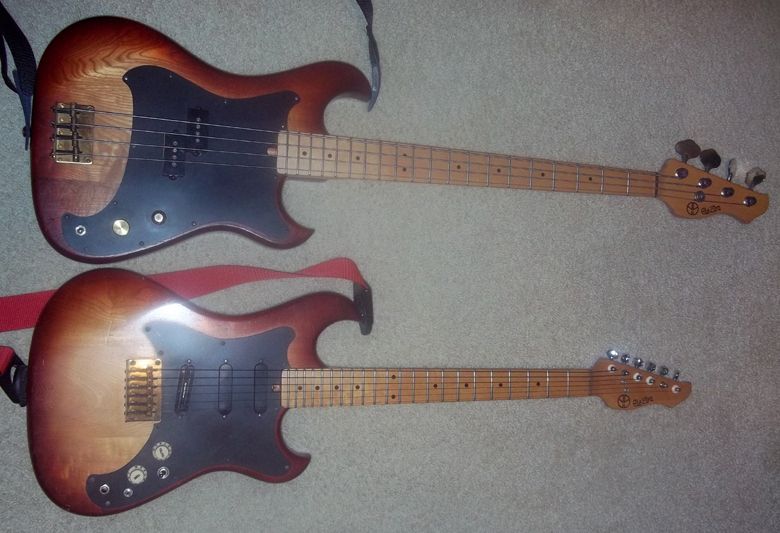
Today I've got something kind of special to me. My first serious guitar was my Electra Phoenix X-140S. While perusing eBay yesterday, I saw a matching bass, a Phoenix X-630S. I thought I'd just be dreaming, until I noticed it was at a local shop. There was a bit of a frantic search when the employees couldn't locate it, but eventually it was found.
It's pretty basic, one pickup, volume and tone. Maple neck/fretboard, ash body, brass hardware.
My one complaint is that it is setup with flatwounds. I'll be getting some new strings promptly.
Tyler
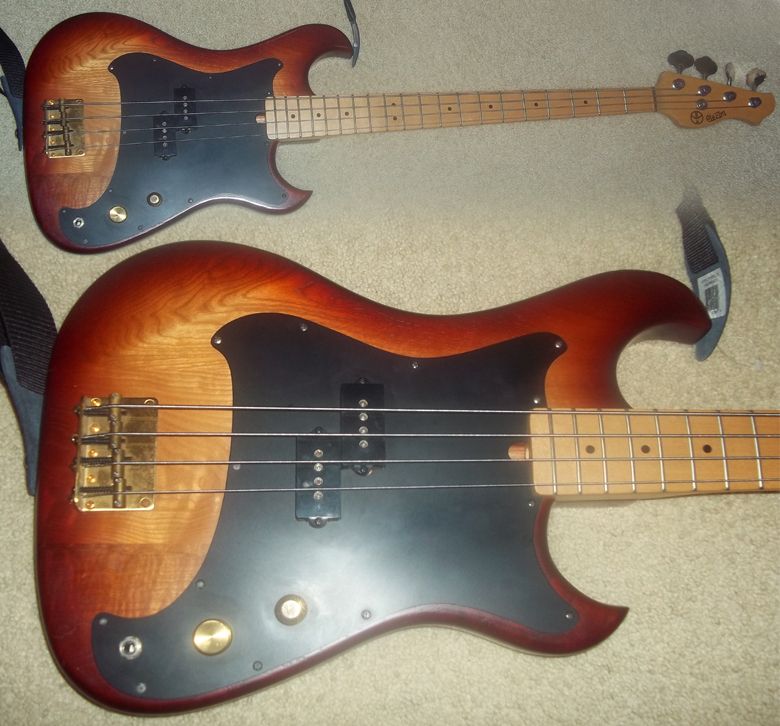 Nice find! While these are not some of more highly desirable Electra guitars and basses with built-in effects modules, the brand is known for its high quality of manufacture and playability. These Japanese-made guitars were probably made by Matsumoko, the design being reminiscent of the Westone brand.
G L Wilson
© 2011, Guitarz - The Original Guitar Blog - now in its 10th year!
Duff McKagan Fender P-bass / snowboard hybrid!
guitarz.blogspot.com:
Here's an email from JPM:
G L Wilson
© 2011, Guitarz - The Original Guitar Blog - now in its 10th year!
Here's an email from JPM:
Longtime Guitarz reader, it's an amazing blog.Hey, thanks for that JPM. We've seen a few guitars already made out of pieces of sporting equipment (cricket bat guitar, tennis racquet guitar, even a guitar made from a boat oar) so I guess it figured sooner or later we were going to get a guitar convered into a piece of sporting equipment instead!
Anyways, I don't know if you're aware of this or not but I just saw on YouTube a snowboard company that build a snowboard out of a Duff McKagan Fender P-bass that is both playable and rideable - its pretty crazy. They even have footage of it being ridden accompanied with a sound from the pickups that they hooked up to a wireless rig.
Check it out, I figured you'd appreciate something like this.
G L Wilson
© 2011, Guitarz - The Original Guitar Blog - now in its 10th year!
Saturday, November 19, 2011
Unusual one-off 5- and 6-string through-neck doubleneck guitar
guitarz.blogspot.com:

Steve writes:
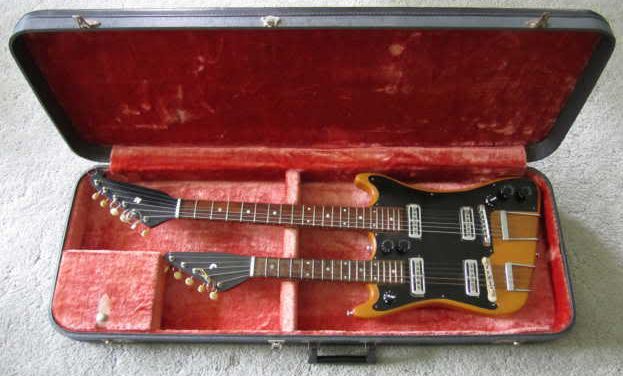
 Also looking at the shape of the 5-string neck's headstock and comparing it to that of the 6-string, I wondered if it had also been a 6-string but part of the head had broken off and thus it was converted. However, the positioning of the rather cheap Japanese Teisco-like pickups on the 5-string side of the guitar so that the 5-strings align to 5-pole pieces with the one on the bass side left unused would imply otherwise - unless it was a later mod.
All in all, it's a very curious guitar and worthy of our attention here on Guitarz.
G L Wilson
© 2011, Guitarz - The Original Guitar Blog - now in its 10th year!
Steve writes:
Hi, I enjoy your Guitarz Blog and recently found this strange item advertised in a local Buy/Sell. I was tempted to buy it, but the $200 asking price and impracticality of such a guitar made me pass. There are probably more than $200 worth of vintage parts on it, though.Impractical it may be, but it would be a real shame to break up a one-off instrument like this for parts. It looks to be hand-made, possibly by a luthier although no-one of great distinction. Note how the short-scale 5-string neck's fretboard position markers echo those on the 6-string neck from the 6th fret upwards. I briefly wondered if the necks may have come from donor instruments with the 5-string neck being shortened and with a headstock grafted on, but of course these are through-necks so that wouldn't really be possible. Perhaps the fingerboards themselves came off other guitars?
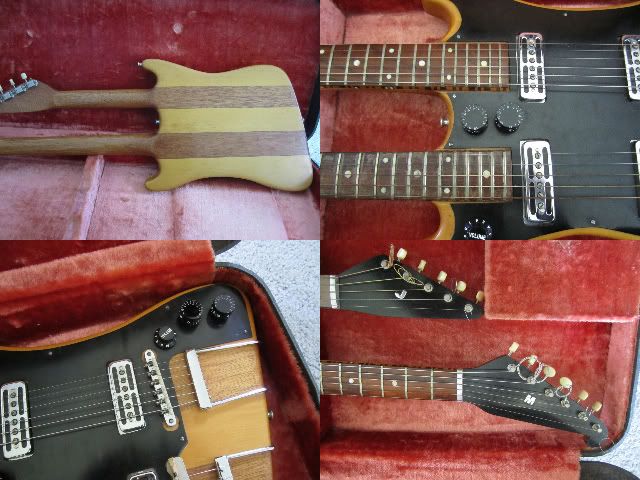
All in all, it's a very curious guitar and worthy of our attention here on Guitarz.
G L Wilson
© 2011, Guitarz - The Original Guitar Blog - now in its 10th year!
Friday, November 18, 2011
Guest Post by Robert Swartwood

Robert sez: Scott Snyder is the reason I finally started self-publishing. But it's not his fault.
Let me explain.
Growing up I was the type of geeky writer who, when walking through a bookstore, would look at the copyright pages of novels to see what printing they were in. I knew all the major publishers and their imprints by heart. I could list off editors and their writers and agents and their clients like a kid naming off the stats to his favorite baseball players. Every week I checked out the new fiction reviews in Publishers Weekly and the new bestsellers in the New York Times.
Yeah, for me writing wasn't so much a hobby as something I wanted to do with the rest of my life. In my head major publishing had become, for lack of a better word, romanticized.
Just after college I scored my first agent and immediately thought I had made it. After all, once you get an agent the rest is smooth sailing, right?
Newsflash: nope, not at all.
This agent shopped two of my novels, a thriller and a literary novel, both which were ultimately rejected. But, strangely enough, both novels received great feedback from publishers. Not every publisher really liked the books, of course, but there were some who did. In fact, one senior editor at Doubleday even called my agent telling him how much she loved the thriller ... but just didn't think it was a right fit for Doubleday.
This agent and I split ways and I was agentless for awhile but kept writing. Eventually I signed with another agent, a much bigger agent at a much bigger agency. Before I had signed with this new agent, I asked what would happen if, God forbid, the novel didn't sell. He said, "We go onto the next book." It was the perfect answer, because many agents won't want to waste their time on a new client whose novel doesn't sell. In fact, this particular agent was still working with clients who hadn't sold novels even after eight or ten tries.
And yet, my two novels with this agent didn't find a home. Again, a lot of great feedback from publishers who seemed to genuinely like the books, but no offer.
Then, in the spring of 2009, I came up with this idea of Hint Fiction and word spread quickly across the internet and a very strange thing happened: W. W. Norton approached me about putting together an anthology of very tiny stories. It was one of those publishing ironies, that after all these years of trying to find a publisher, a publisher found me.
A week or two later, Joe Konrath -- maybe you've heard of him -- spent the night at my place. He was in the middle of his insane driving tour to promote his horror novel Afraid. We drank microbrew beer and talked about books and publishing. At this point Joe had started publishing some of his novels as ebooks but wasn't having major success, at least not yet. He mentioned how he was having trouble with his publisher for the followup to Afraid, how his editor wanted him to make changes that he didn't really want to make. While he didn't come out and say it, I think he knew then that he was going to go it alone with that book.
A year and a half later Hint Fiction: An Anthology of Stories in 25 Words or Fewer came out to glowing reviews from the likes of The New Yorker and The Los Angeles Times. I did a little tour, going from Los Angeles to New York City, and was even interviewed by Scott Simon on NPR's Weekend Edition Saturday. It was a lot of fun and a great experience but, I think, really helped kick that romanticized idea of major publishing out of my head. While I loved working with the people at Norton -- I had a lot of creative control, actually, more so than some writers get -- there were still some limitations that I didn't care for. When I had suggested about possibly lowering the price of the ebook for a week or two as a promotion, the idea was immediately shot down with the standard answer that ebooks should cost the same as the paperback.
Around this time I got an iPad. I used it less for games and watching movies than reading and editing. I began to buy more and more ebooks, loving the convenience and the idea that basically wherever I went, I had a book to read (everyone should have the Kindle app downloaded on their phone). The ebook prices ... well, it depended on the author -- sometimes the prices were good, sometimes they weren't. Most of the ebooks released by major publisher were priced at $9.99 or more, with the paperback version costing about the same. One of these ebooks was Voodoo Heart by Scott Snyder, a short story collection I had been hearing so many great things about. It was priced at $9.99, and I told myself I would come back to it sometime later.
Before then -- this was in the winter of 2010 -- I had self-published three ebooks, but they were just 99 cent novellas and stories and didn't sell very well. I was holding onto the novels because, again, I had that romanticized idea of major publishing in my head and knew that the sale of a first novel was important. But then, in February of this past year, Random House finally gave in to the agency pricing model at Amazon, meaning they could now set the price to whatever they wanted.
And would you know how much Scott Snyder's Voodoo Heart became?
Not $9.99, but $14.99! (It's currently $11.99 at Amazon.)
While advances are always nice, the one thing authors count on are their backlist. The more books they have to sell, the more readers can find those books and buy those books and keep money coming in for those writers. But when publishers start pricing their ebooks even higher than the paperback books, it's just ... strange. How is that beneficial for anyone? Certainly not for the author and publisher, and most certainly not for the reader. Even if I sold a novel to a publisher and got a decent advance, I knew deep down the ebook price would be really high and would continue being really high, even years and years after publication.
One night Blake Crouch and I had a very long conversation on the phone. Months back he had self-published Run which was doing very well. At the time I was debating whether or not to get my MFA in creative writing, with the plan being that I would eventually teach at the university level. Blake said, "If you could choose between teaching and writing full time, which would you pick?"
I sort of laughed, thinking the answer obvious, and said, "Writing full time."
Blake said, "Then do it."
Blake asked me what my most commercial book was, and I told him it was my thriller The Serial Killer's Wife, which was currently with my agent. He said he wanted to read it based on the title alone and that I should definitely put it online myself (he also hooked me up with his designer, the super talented Jeroen ten Berge). Still I was hesitant, and a while later talked to my agent about it. He confessed that it was harder than ever to crack into the thriller market and understood if I wanted to self-publish the book instead (he has other clients who have been self-publishing too). So this past summer I released the novel (along with a foreword by Blake) and it's been doing well ever since. I have it priced at $2.99, as well as my two other novels, and I've been selling over 1,000 ebooks a month on Kindle and right now earning on average just over $1,500 a month. I recently released another thriller, Man of Wax, which is the first book in a trilogy.
(I also should note that in May of this past year Amazon made one of my titles -- The Silver Ring -- available for free on Kindle (it's now 99 cents). When I initially received the email, I wasn't sure what to think, but then instantly I realized this promotion could be a great opportunity. I quickly added an excerpt from my supernatural thriller The Calling at the end of the novella, as well as an excerpt from The Serial Killer's Wife with a note that said it was coming soon. I thought I would be lucky if the ebook was downloaded over 5,000 times. Turned out that, in less than a month, it was downloaded 25,000 times, and the sales of my other ebooks picked up drastically.)
I'm still with my agent but unsure yet if I ever want to sell another book to a major publisher again. I'm certainly not against the idea, but there will have to be a lot of money to give up all of my rights. If anything, I think the dream for any indie author is to sign with Amazon, as their marketing is completely unmatched. But still, my agent understands the marketplace and continues to try to sell subsidiary rights; in fact, he sent The Serial Killer's Wife out to a film agent who liked it and is currently showing it to some directors. Will anything come from it? Probably not. But still it's good to see that my agent keeps an open mind and is still willing to work with me.
The most important thing I've learned about self-publishing, though, is that just because you can do something, doesn't necessarily mean you should. Sure, self-publishing has become easier than ever and makes a lot of sense to do so, but writers need to be sure that they have a great product first and foremost. There are novels on my hard drive that I could easily self-publish, but I won't. I know they're not good enough yet, and maybe never will be.
It's also important to note that a lot more work goes into self-publishing. It no longer becomes a hobby, or a dream, but rather a business. There are a lot of upfront costs involved, costs that usually a publisher takes care of. You become responsible for your cover art and your formatting and even your marketing. These can become exhausting, but at the same time, it's all an investment. Ideally, you'll earn that money back and keep earning.
I should also note that I've been lucky. Some writers have a lot of books out with great cover art and product descriptions and they aren't selling at all. A lot of writers spend time on message boards, but I don't find that very useful as mostly everyone on those message boards are writers just trying to sell their books too. What we need to focus on instead are the readers.
After all, without readers, what's the point?
Joe sez: First of all, congrats to Rob and the success he's having. He's doing a good job playing the game, and as the years pass and he keeps uploading professional content, he's going to earn more and more money.
Second, it was very cool that Blake took the time to not only talk at length with Rob about self-publishing, but also endorse Rob's book. Now Rob is sharing his story with the world, which may inspire other authors to take the plunge.
This is why legacy publishers should be very, very afraid. While profits are up at legacy houses (Kristine Rusch has a great post about this) I believe we're at a tipping point. While Kris doesn't believe legacy publishing is going away, I believe it is, because more and more authors are going to discover that they can go it alone. Right now publishers have a bumper crop of titles they can sell at too-high prices while reaping 52.5% royalties. But in two years, as ebook sales continue to climb, authors are going to wise up. They must, because they're getting hosed.
Rob's story is unique to him, but it tells a universal tale of rejection and eventual success. He has found out, on his own, that self-publishing is the way to go. Many others are finding this out as well.
This is how revolutions start. First, there is unrest and unhappiness. Then a few folks figure out a better way, and begin talking about it. Then more and more people try it and share what they've learned. Eventually the status quo changes.
Consider this: if you are a writer, you WILL self-pub eventually. You'll have to, because it will be the only choice left. Now, you can try to suck a few bucks out of the legacy publishing world before it dies IF you're lucky enough to get accepted and IF you're willing to bend over and take their terrible offer. If you do this, I predict you'll be counting the days until you get your rights back so you can self-publish.
Or you can self-publish now, and start earning money now.
Every day you wait is a day you didn't make money.
Thursday, November 17, 2011
1960s Italian wonder Meazzi Zodiac


At first sight, this Meazzi Zodiac looked to me like a small body travel guitar à la Eko Short Gun, then I found this picture of Swiss musician Lili Zeller playing the Zodiac (on fetishguitars.com, like usually when one needs info about Italian vintage guitars), and like me you can see that despite its unusual design, it's a well proportionate and well balanced instrument. I'm happy to have found this guitar today, it's exciting and inspiring, for both a musician and a guitar maker, not to mention a collector...
Unfortunately this one lacks its bridge and trem arm, but they should be easily replaceable, mostly if you take the opportunity to install an upgraded model of bridge, after all, what matters is how well it plays! Meazzi guitars had all you can expect from Italian vintage ones: odd designs, unique pickups and trems, strange controls and plenty of chromed plates! Meazzi started in the 1950s with Antonio Wandré Pioli for designer, who released his first instruments as Framez - a Meazzi sub-brand.
Bertram Unfortunately this one lacks its bridge and trem arm, but they should be easily replaceable, mostly if you take the opportunity to install an upgraded model of bridge, after all, what matters is how well it plays! Meazzi guitars had all you can expect from Italian vintage ones: odd designs, unique pickups and trems, strange controls and plenty of chromed plates! Meazzi started in the 1950s with Antonio Wandré Pioli for designer, who released his first instruments as Framez - a Meazzi sub-brand.
© 2011, Guitarz - The Original Guitar Blog - now in its 10th year!
Subscribe to:
Posts (Atom)